






 Assessment
Leadership Insight:
Leadership Trust Index (LTI)
- Is your CEO trusted? Have you asked your team—rather than your CEO—this question?
- Which trust habits are your leaders strong in, and where are their blind spots?
- Where does your board rank on the BE KIND score? (Spoiler: This is often the weakest area for many leaders.)
- Do your leadership development programs rely on measured trust—or assumptions?

55% Trust Gap
Only 55% of employees trust their CEOs. (Edelman Trust Barometer)
+29% Perception Gap
CEOs perceive themselves as 29% more trustworthy than employees actually see them. (Trust Across America)
70% Resignation Risk
70% of employees consider leaving because of their manager. (Gallup)
82% Distrust
82% of employees believe their CEO is not truthful. (Edelman Trust Barometer)
1/3 Trust in Senior Leadership
Only one-third of employees trust senior leadership. (Harvard Business Review)
50% Information Withholding
Half of employees hide information from their managers. (Harvard Business Review)
-
 15–20 minutes
-
 ~45 questions (9 habits × 5)
-
 1 (Individual) / 5+ (360°)
-
 Leadership Insight
Comparison: Managing Without Data vs. With LTI
 Without Knowing the Trust Index
 With the Trust Index
Trust Measurement
Intuition and guesswork — “I think my team trusts me.”
Clear insight into which leadership behaviors need improvement.
Blind Spot Detection
A +29% perception gap between CEO self-perception and employee perception.
Alignment between how leaders see themselves and how employees perceive them, enabling a high-trust environment.
Development Plan
Generic leadership training for all managers.
Personalized development actions (e.g., if BE KIND score is low → empathy coaching).
Benchmarking
Limited perspective based on internal opinions.
Global Leadership Trust Benchmark.


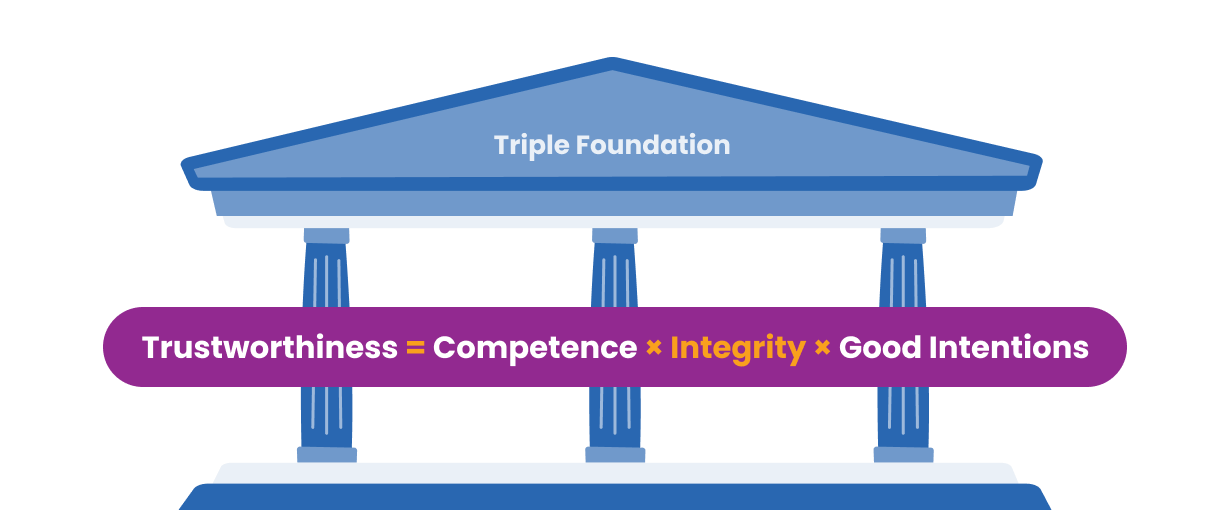
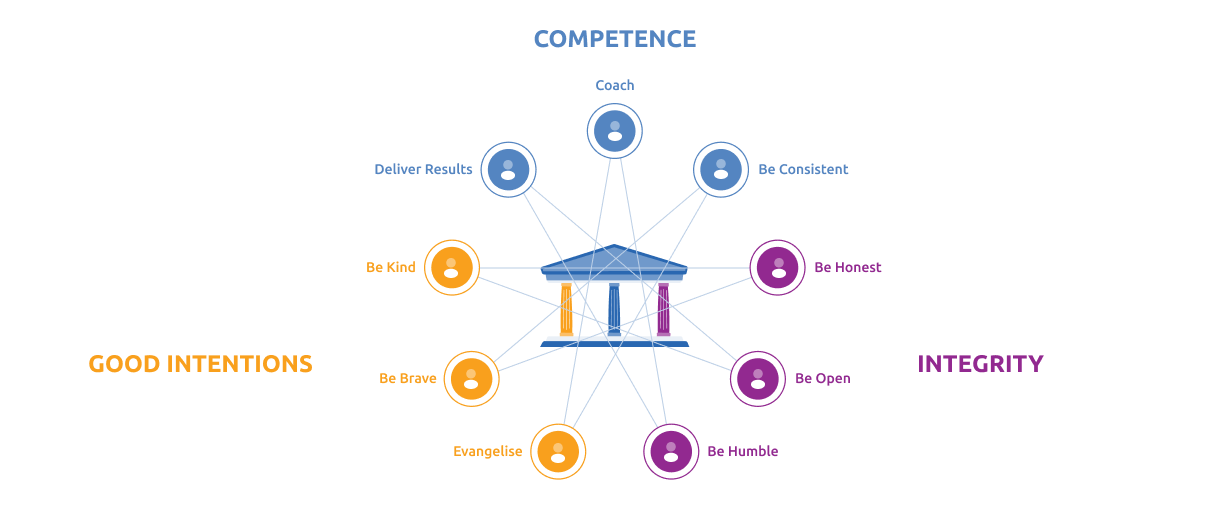
Trustworthiness = Competence × Integrity × Benevolence. A multiplicative formula—if any factor is zero, the entire trust score collapses.
For example:
If a CEO scores 10/10 in DELIVER (results) but 3/10 in BE KIND, overall trust remains low.
Leadership Trust Index — Product Overview

Leadership Trust Index (LTI)
Product Name
Leadership Insight
Category
SP Custom (Dr. John Blakey IP)
Partner
LEC (Primary) | STRG | LERG | GROC | PERC | INHR
Challenge
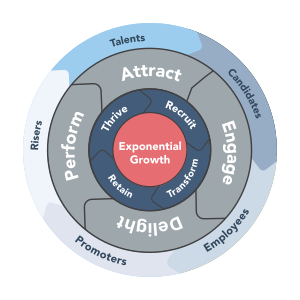
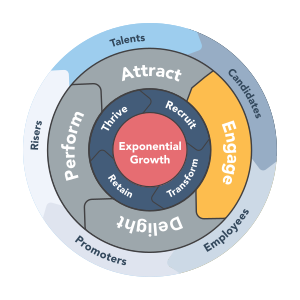
ENG (Engage)
Flywheel
CEO, CHRO, Senior Leaders, Board of Directors
Target Audience
~45 questions (9 Habits × 5)
Number of Questions
15–20 minutes
Completion Time
1 (Individual) / 5+ (360°)
Minimum Participants
3 Pillars × 9 Habits = Nine Habits of Trust®
Methodology
Online Platform (instant results)
Delivery Method
Turkish / English
Language Options
Individual + Team + Organizational + Perception Gap
Reporting
Global Leadership Trust Benchmark
Benchmark
Industry / Organizational / Role-based
Customization
Assessment + Individual Report + 1:1 Debrief
Package Includes
Provided (by SP1)
Project Manager
Trust Coaching, Team Workshop, Transformation
Optional Services
Related Success Programme Solutions
 Related Assessments
360° Leadership Assessment (SP)
Team Psychological Safety Index (SP)
Manager Effectiveness Survey (SP)
Everything DiSC® Work of Leaders (WLY)
Show More
Related Training & Consulting
Trust-Centered Leadership (COA)
Executive Coaching (COA)
Implementing 360 Feedback (CON)
Crucial Influence for Behavioral Change (PTP)
Social Style Training (PTP)
Everything DiSC® Lead with Impact (PTP)
Show More
Statistics for Sales & Marketing
Trust & Performance
A 1/8 increase in trust = 2.5% profit increase (Cornell)
CEOs perceive themselves 29% more trustworthy
82% CEO distrust (Edelman)
70% consider leaving because of managers
55% trust their CEO (Edelman)
50% withhold information (HBR)
Daha Fazla Göster
Trust Model
Based on 6 years of doctoral research (Aston Business School)
3 Pillars × 9 Habits = Multiplicative formula
Benevolence is typically the weakest pillar
BE KIND is often the lowest scoring habit
Daha Fazla Göster
References
Dr. John Blakey — The Trusted Executive (Kogan Page)
Trust Across America — Top 100 Trust Leader
ILM — Openness = #1 driver of trust
Daha Fazla Göster