






 Assessment
CX Insight:
NPS Survey
-
How many of your customers truly recommend you—or do you only assume they do?
-
Have you ever calculated how much revenue your Detractors silently cost your business?
-
Bain & Company states: “NPS leaders outperform their competitors by more than 2×.” — Where do you stand in your industry?
-
If you knew who your Promoters were, couldn’t you turn them into powerful referral engines?
-
Reichheld selected just 1 question out of 19 because the likelihood to recommend is the strongest predictor of future growth. Are you asking that question?

2x+
NPS leaders grow more than twice as fast as the industry average — (Bain & Company)
4.2x
Promoters are 4.2 times more likely to repurchase than Detractors — (Temkin, 2017)
2/3
Two-thirds of Fortune 1000 companies use NPS — a global standard metric.
-
 2 Mins
-
 3 questions (0–10 NPS + reason for choice + open-ended question)
-
 100+ responses (for statistical reliability)
-
 CX Insight
If NPS Is Not Measured Vs. If It Is Measured
#
 If NPS Is Not Measured
 If NPS Is Measured
1
Only 1 out of 26 dissatisfied customers complains; the other 25 leave silently (ThinkJar)
A three-layer early warning system is established through Promoter / Passive / Detractor segmentation.
2
Acquiring a new customer is 5–25× more expensive than retaining an existing one (HBR)
Promoters are 4.2× more likely to repurchase, turning into an engine for organic growth (Temkin, 2017).
3
Cost per Detractor: −$57; Revenue per Promoter: +$328 — a 6× difference (Dell/Bain)
With a closed-loop system, converting 2–8% of Detractors can generate $167M in additional annual revenue (Dell/Bain).
4
Your industry position remains unknown, and benchmarking against competitors is not possible
NPS explains 20–60% of the difference in organic growth (Bain).
5
89% of consumers switch to a competitor after a poor customer experience (Oracle)
+7 NPS points = 1% revenue growth (LSE, 2005); +10 points = 3.2% increase in upselling (CustomerGauge, 2022).
6
Customer experience performance is evaluated subjectively, making it difficult to present concrete metrics to the Board
Two-thirds of Fortune 1000 companies use NPS—a universal, single-number, board-ready metric.
Customer Voice


“Until we started measuring NPS, we didn’t realize that 22% of our customers were Detractors. Within the first six months, we reduced the Detractor rate from 22% to 11% through Closed-Loop actions. Each converted Detractor generated an average of ₺85,000 in additional annual revenue for us.”
— CX Director
B2B Technology Company
“With the NPS program, we increased our Promoter rate from 35% to 58%. The share of customers coming through referrals rose from 12% to 28%. Now, in board meetings, the NPS trend is considered just as important as sales data.”
— CXO
Telecommunications Sector
Product Overview — Specifications

NPS Survey (Net Promoter Score Survey)
Product Name
CX Insight — Measurement Layer
Survey Category
SP1 In-House
Partner
CUSI
Product Category Code
Execution
Challenge Tier
CXD (Customer Experience Design)
Expertise
Growth & Revenue (GRO)
Responsibility Area
Reichheld NPS (2003) + Closed-Loop Feedback + Sectoral Benchmarking
Methodology
CXG (Primary) | GROC | INSM | PERC | STRG | RESC
Challenge
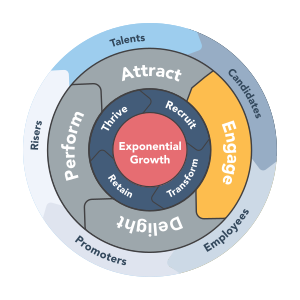
ENG (Engage)
Flywheel
CRO (Chief Revenue Officer) | CXO | Sales & Marketing Leaders
Target Audience
3 questions (0–10 NPS + Reason for Score + Open-ended question)
Number of Questions
2 minutes
Completion Time
100+ responses (for statistical reliability)
Minimum Participants
QuestionPro Online Platform (email / link / SMS / QR code)
Delivery Method
TR / EN (Multilingual survey)
Language Options
NPS = % Promoter − % Detractor (−100 → +100)
Scoring
NPS Score + Trend + Segment Distribution + Benchmark + Detractor Analysis + Open-ended Theme Analysis
Reporting
Industry NPS Benchmark + Periodic Trend (T1 vs T2)
Benchmark
Touchpoint-based NPS (Sales, Support, Onboarding) + Customer segment breakdown
Customization
Project Manager
Included
Project-based (depending on organizational size and scope)
Pricing
Related Solutions
 Related Assessments
CSAT Survey
Customer Effort Score (CES
Customer Health Score
Customer Retention Survey
Products/Services to Consumers (B2C)
Products/Services to Businesses (B2B)
Company Satisfaction
Show More
Related Training & Consulting
CON: Sales & Marketing Transformation, Customer Experience Strategy
PTP: Customer Success Fundamentals, Data Literacy for CX Teams
COA: CX Leadership Coaching, Customer-Centric Team Coaching
SPK: The CX Revolution: From Measurement to Action
Show More