

task-square Assessment

Leadership Insight:

Strategy Execution Index

  • Your strategy may be excellent — but have you actually been able to implement it?

  • Can your employees explain the strategy in their own words?

  • Are daily decisions truly aligned with strategic priorities?

  • Are resources allocated based on habit or according to strategy?

depositphotos_185065418-stock-photo-business-risk-strategy-and-planing
67%
The rate at which strategies fail.(McKinsey)
95%
The percentage of employees who do not know their company’s strategy. (Kaplan & Norton)
3x
Performance advantage of companies that excel at strategy execution.(Harvard Business Review)
  • clock 38–45 min (Full) | L0: 8–10 min
  • questionmark 102 (95 Likert-scale + 7 reverse-coded + 5 open-ended)
  • sdasd 10+ participants (from different organizational levels)
  • asdasddas Leadership Insight

Globally, 70% of strategies fail — not because the strategy itself is flawed, but because of the gap between strategy and execution.

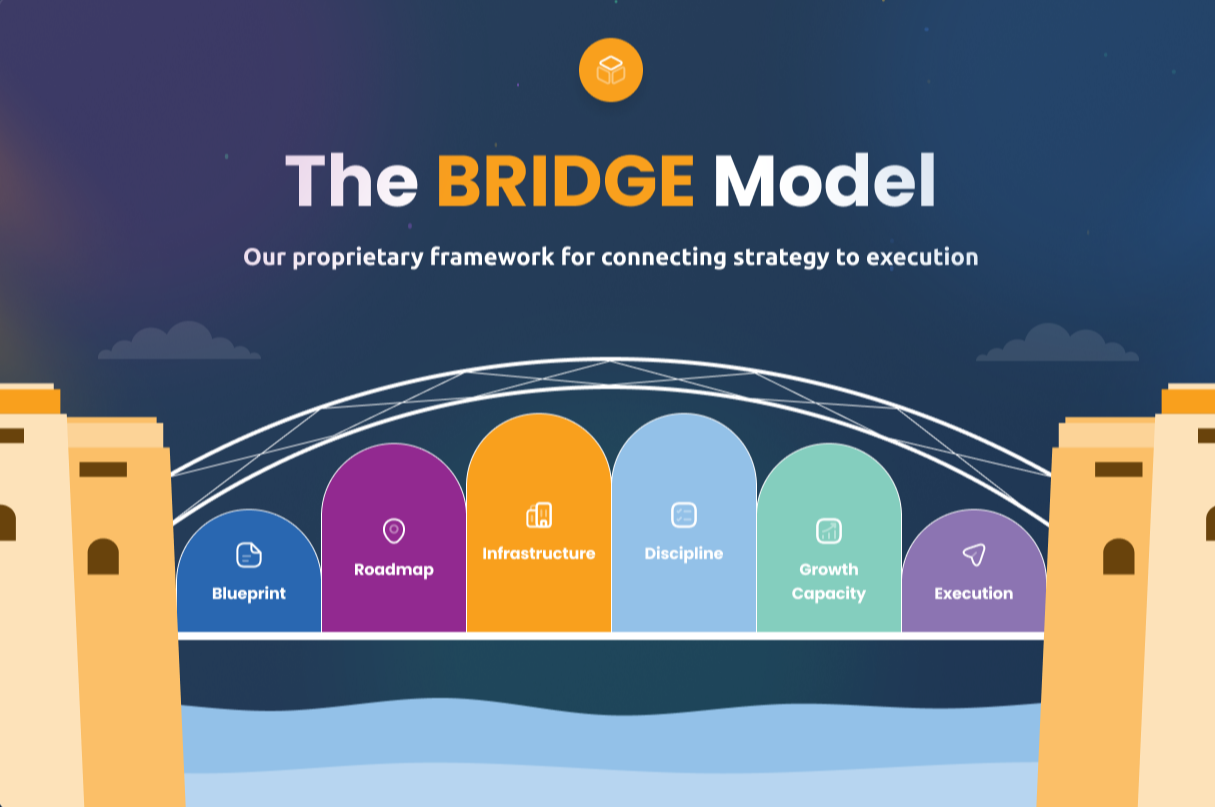
The BRIDGE model bridges this gap through six critical components:

close-circle-white Component
tick-circle-white What It Measures?
B
Blueprint
Is the strategy clear? Does everyone see the same picture, or does everyone have a different interpretation?
R
Roadmap
Is there a plan? Have resources been allocated? Has the strategy been transformed into a true roadmap, or does it remain only a presentation?
I
Infrastructure
Do systems, processes, and tools support the strategy, or do old habits dominate?
D
Discipline
Are KPIs monitored regularly? Are responsibilities clearly defined? Are deviations detected and corrected?
G
Growth Capacity
Do your people have the capabilities to execute the strategy? Where are the capability gaps?
E
Execution
Are results being produced? Are targets achieved? Does completed work truly represent success?

Key Findings

Strengths
B- Blueprint (78) High clarity of strategy
G-Growth Capacity (75) Strong organizational agility
E-Execution Results (74) Tangible results are being achieved
Areas for Improvement
D-Discipline (65) Weak execution discipline
I- Infrastructure (68) Structural gaps

What is the Strategy Execution Index?

The Strategy Execution Index (SEI) is a seven-layer strategy audit tool developed by SP1 that measures how effectively organizations translate their strategies into execution. It systematically evaluates the gap between strategy and execution, identifying where and why issues occur through measurable data.

The methodological framework of SEI was inspired by leading research in strategy execution. It draws on foundational sources such as Kaplan and Norton’s Strategy Maps approach, Charan and Bossidy’s Execution Discipline model, Neilson’s research on organizational decision structures, Sull’s coordination theory, and McChesney’s disciplines of execution. 
 

SEI synthesizes these insights with SP1’s field experience and market-specific perspectives, transforming them into a proprietary measurement model.
0-1-1

Layer 0 — Strategy Development Audit
C-Suite & Strategy Team
17 questions | 8–10 minutes

Layers 1–6 — Strategy Execution Index
Entire Organization
85 questions | 30–35 minutes

This is not an individual competency survey; it is an audit tool that evaluates the organization’s capacity to execute its strategy.

At the heart of SEI lies the BRIDGE Framework, a six-dimensional model formed from the initials of Blueprint, Roadmap, Infrastructure, Discipline, Growth, and Execution. This structure is built on a two-module architecture:
speedometer

Module 1 - Strategy Development Audit (Layer 0):

Evaluates the strategy itself through 17 questions directed at the C-Suite and strategy team. Are strategic choices clear? Has risk analysis been conducted? Is the organization adequately prepared?

speedometer

Module 2 — BRIDGE Execution Audit (Layer 1–6):

Measures how the strategy cascades across the organization through 90 questions and 5 additional control questions, covering 29 sub-dimensions across different management levels.

With 7 layers, 29 sub-dimensions, and 107 questions, SEI provides a comprehensive audit that examines strategy execution from end to end. Each layer is scored independently, revealing precisely where the organization is strong and where it is vulnerable.


SEI Output 

profile-2user

Layer-based gap analysis

identifies exactly where the issue occurs
profile-2user

Perception gap

mapping across management levels reveals differences in perspective between senior leadership and operational levels
profile-2user

BRIDGE-based action plan

prioritizes actions required within each layer
profile-2user

Benchmark score

provides a quantitative reference for periodic comparison and progress tracking

82% of strategies are never measured.

Yours probably isn’t either.
— StratNav, 2026

What Happens Without Measurement vs. What Changes When You Measure?

 
Problem
close-circle-white Without Measurement
tick-circle-white With Measurement (SEI)
Strategy Success
70% of strategies never materialize. Plans that look excellent on paper disappear in execution, and the root cause remains unknown.
SEI identifies the exact layer where the strategy is blocked, enabling data-driven answers to whether the issue lies in strategy or execution.
Value Loss
Companies capture only about 60% of the value expected from their strategies; the remaining 40% disappears without visibility.
Layer-based deviation analysis reveals whether losses originate from planning, communication, or execution.
Functional Alignment
67% of key functions operate without alignment with company strategy.
Departmental alignment scores reveal which functions support the strategy and which do not.
Employee Awareness
67% of employees do not know their role when a new initiative begins.
SEI measures how well employees understand and adopt the strategy.
KPI Tracking
92% of organizations do not track performance indicators relative to competitors.
SEI establishes a KPI chain from strategic planning to operational execution.
Leadership Focus
Leadership teams spend less than one hour per month on strategy.
Regular SEI measurement keeps strategy on the leadership agenda.
Accountability
45% of managers cannot track the implementation of strategic initiatives.
Responsibility and progress metrics establish a culture of accountability.
6

7-Layer Framework Details — Product Overview

BRIDGE Layer/ Sub-Dimension Questions Source
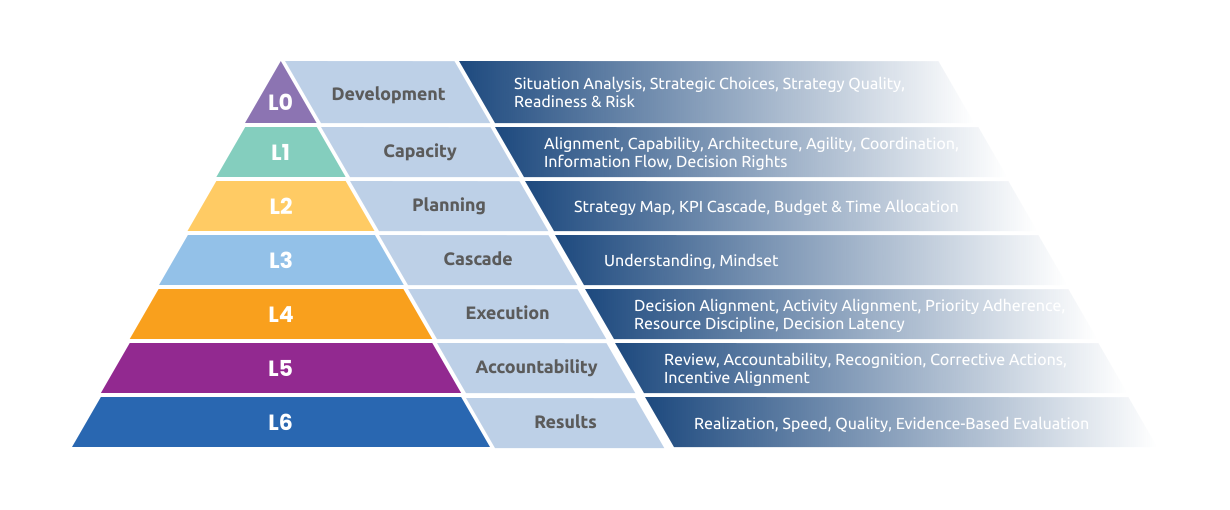
B (L0: Development) Situation Analysis, Strategic Choices, Strategy Quality, Readiness & Risk 15 + 2 control SP1 Original
B + G (L1: Capacity) Alignment, Ability, Architecture, Agility, Coordination, Information Flow, Decision Rights 20 Darden 4A + Neilson
R (L2: Planning) Strategy Map, KPI Cascade, Budget / Time Allocation 13 Kaplan–Norton XPP
R + I (L3: Cascade) Understanding, Mindset 9 SP1 Research
I + D (L4: Execution) Decision Alignment, Activity Alignment, Priority Adherence, Resource Discipline, Decision Latency 21 SP1 + Premium
D (L5: Accountability) Review, Accountability, Recognition, Correction, Incentive Alignment 14 SP1 + Kaplan
E (L6: Results) Realization, Speed, Quality, Evidence-Based Evaluation 10 + 3 control SP1 Original

What Value Does It Bring to Your Organization?

Challenge Cost SEI Solution Outcome
Strategy gets shelved during the year 67% strategy failure rate (McKinsey). Loss of 10% of annual revenue. 63% of strategy value never realized = $2 trillion global loss Identify execution gaps with the 7-layer BRIDGE audit. BRIDGE scoring + 2×2 matrix (Strategic Capability vs Execution Results) Clear roadmap from strategy to results. Strategically aligned companies are 30% more profitable (McKinsey) and show 3× performance advantage (HBR)
Employees do not know the company strategy 95% of employees are unaware of the strategy (Kaplan & Norton). Ownership is near zero; execution becomes impossible. Cascade questions measure awareness and adoption of strategy. Increased awareness and ownership. Engaged employees exert 57% more discretionary effort (Economist)
Daily operations override strategy Leaders become overwhelmed by operations. 85% of leadership teams spend less than one hour per month on strategy (Kaplan & Norton). Execution questions measure decision and activity alignment, priority management, resource discipline, and change fatigue. Stronger strategic focus — 3× performance advantage (HBR)
Strategy-related KPIs remain theoretical Leaders fail to allocate time to strategy. Resources are wasted on the wrong objectives. Planning questions measure KPI cascade and budget alignment with strategy. Correct metrics and measurable progress
Lack of accountability in strategy execution 70% of employees consider unmeasured goals to be at risk (Partners in Leadership). Low accountability cultures show 21% lower productivity and 22% lower profitability. Accountability questions evaluate review processes, incentive alignment, and corrective mechanisms. Strong accountability culture and sustainable performance. Companies with strong accountability cultures achieve 2.5× higher revenue growth

Product Details

SP1 Strategy Framework (SEI) — Strategy Execution Index

profile-2user

SP1 Strategy Framework (SEI)

Product Name

Leadership Insight (SP Custom)

Category
profile-2user

SP1 In-House (Original Research)

Partner
profile-2user

STRG | LEC | PERC | GROC | RESC | TALS

Challenge
profile-2user

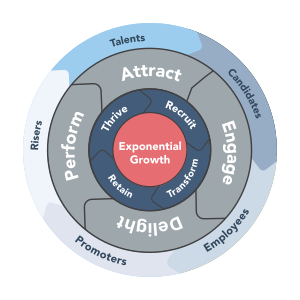
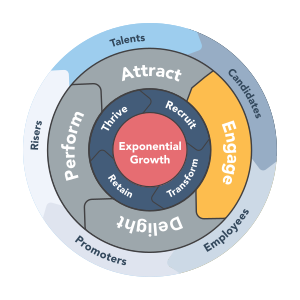
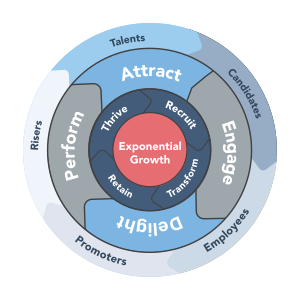
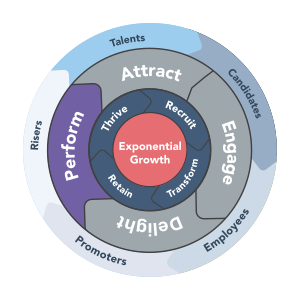
ENGAGE

Flywheel
profile-2user

CEO, CHR, TAL, Strategy Teams

Target Audience
profile-2user

102 (95 Likert-scale + 7 reverse-coded + 5 open-ended)

Number of Questions

38–45 minutes (Full) | L0: 8–10 minutes

Completion Time
profile-2user

L0: C-Suite Audit + L1-6: BRIDGE Org Execution Index

Modules
profile-2user

7 Layers | 29 Sub-dimensions

Layers
profile-2user

BRIDGE Framework (Blueprint, Roadmap, Infrastructure, Discipline, Growth, Execution)

Methodology
profile-2user

10+ participants (from different organizational levels)

Minimum Participants
profile-2user

5-point Likert scale (1 = Strongly Disagree)

Scale
profile-2user

Online Platform

Delivery Method
profile-2user

TR / EN

Language Options
profile-2user

Darden 4A + Kaplan–Norton XPP + Neilson/Sull

Academic Foundations
profile-2user

Industry + internal organizational benchmark

Benchmark
profile-2user

v2.1 (BRIDGE Premium)

Version
profile-2user

Org + BRIDGE + Sub-dimension Based + Benchmark

Reporting
profile-2user

Development measured through Re-Audit

Follow-up
profile-2user

Coaching, Workshop, Action Plan

Optional Services

Related Solutions

power-of-habit CON — Consulting

Strategy to Execution

Partner- SP

power-of-habit CON — Consulting

Future Design

Partner- SP

power-of-habit ASS — Assessment

Strategy Execution Index (SEI)

Partner- SP

power-of-habit ASS — Assessment

Defining Your Brand

Partner- SP

power-of-habit ASS — Assessment

Brand Awareness Survey

Partner- SP

power-of-habit ASS — Assessment

Cloud Strategy Assessment

Partner- SP

power-of-habit COA — Coaching

Strategic Thinking & Decision-Making

Partner- SP

power-of-habit PTP — Premium Training

Data Literacy Level 1: Learning to See Data

Partner- SP

power-of-habit PTP — Premium Training

Data Literacy Level 2: Working Effectively with Data

Partner- SP

power-of-habit PTP — Premium Training

Data Storytelling for IMPACT

Partner- SP

power-of-habit PTP — Premium Training

Leading AI Transformation

Partner- SP

power-of-habit PTP — Premium Training

Leading Culture and Workplace

Partner- SP

power-of-habit PTP — Premium Training

Leading Strategy and Innovation

Partner- SP

power-of-habit PTP — Premium Training

Leading Transformation

Partner- SP

power-of-habit ELP — E-Learning

Adaptive Mindset for Resilience

Partner- TRC

power-of-habit ELP — E-Learning

Data Literacy Level 1

Partner- DLA

power-of-habit ELP — E-Learning

Data Literacy Level 2

Partner- DLA

power-of-habit ELP — E-Learning

Data Storytelling for IMPACT

Partner- SP

power-of-habit ELP — E-Learning

Leading AI Transformation

Partner- SP

power-of-habit ELP — E-Learning

Leading Culture and Workplace

Partner- SP

power-of-habit ELP — E-Learning

Leading Strategy and Innovation

Partner- SP

power-of-habit ELP — E-Learning

Leading Transformation

Partner- SP

power-of-habit MLP — Micro Learning

Adaptive Mindset for Resilience

Partner- TRC

power-of-habit MLP — Micro Learning

Data Literacy Level 1

Partner- DLA

power-of-habit MLP — Micro Learning

Data Literacy Level 2

Partner- DLA

power-of-habit MLP — Micro Learning

Data Storytelling for IMPACT

Partner - SP

power-of-habit MLP — Micro Learning

Leading AI Transformation

Partner - SP

power-of-habit MLP — Micro Learning

Leading Culture and Workplace

Partner - SP

power-of-habit MLP — Micro Learning

Leading Strategy and Innovation

Partner - SP

power-of-habit MLP — Micro Learning

Leading Transformation

Partner - SP

power-of-habit SAS — SaaS Platform

Reinforcement Solution

Partner- SP

power-of-habit SAS — SaaS Platform

AI Coaching Solution

Partner- SP

power-of-habit IMP — Implementation

Reinforcement Solution Implementation

Partner- SP

power-of-habit IMP — Implementation

AI Coaching Solution Implementation

Partner- SP

power-of-habit ONB — Onboarding

Strategic Alignment Onboarding

Partner- SP

power-of-habit ENA — Enablement

Go-to-Market (GTM) Enablement

Partner- SP

power-of-habit ENA — Enablement

Change Enablement

Partner- SP

power-of-habit ENA — Enablement

Transformation Capability Building

Partner- SP

power-of-habit ENA — Enablement

OKR Implementation Enablement

Partner- SP

power-of-habit ENA — Enablement

Customized Enablement Programs

Partner- SP

power-of-habit OUT — Outsourcing

Org. Transformation Outsourcing

Partner- SP

power-of-habit OUT — Outsourcing

Marketing Director Outsourcing

Partner- SP

power-of-habit SPK — Speaker

From Strategy to Behavior: Making Transformation Stick

Partner- SP

Sales & Marketing Data

Strategy Execution Index — Supporting Statistics and Sources

These data points can be used in sales discussions, presentation materials, and client proposals. Each statistic has been compiled from reliable sources.

Category
close-circle-white Statistic
tick-circle-white Source
Strategy Failure
67% of strategies fail
McKinsey
Strategy Measurement
82% of strategies are never measured
StratNav, 2026
Employee Awareness
Only 5% of employees understand their company’s strategy
HBR, Kaplan & Norton
Performance Gap
37% gap between planned and actual performance
Mankins & Steele, HBR
Revenue Loss
10% of annual revenue is lost due to poor execution
McKinsey
Strategy Value Loss
63% of strategy value is never realized = $2 trillion loss
ZoomInfo
Transformation Failure
70% of digital transformations fail = $2.3 trillion annually
Gartner
Business Transformation
88% of business transformations fail to achieve their original goals
Bain, 2024
Project Success
Only 48% of projects achieve their strategic objectives
Gartner
Functional Alignment
67% of key functions are not aligned with strategy
HBR
Initiative Tracking
45% of managers cannot track strategic initiatives
McKinsey
Leadership Time
Leadership teams spend less than 1 hour per month on strategy
HBR
KPI Tracking
92% of organizations do not track competitive KPIs
Org. Synergies
Engagement Cost
Low engagement costs $350 billion annually in the U.S.
15Five
Strategy Quality
Only 21% pass the strategy quality test — a 40% decline over the past 15 years
McKinsey 2024–2025
Gain: Profitability
Strategically aligned companies are 30% more profitable
McKinsey
Gain: Engagement
Highly engaged employees generate 23% more profit
Gallup
Gain: Performance
3× performance gap between aligned vs. misaligned organizations
HBR
Gain: Growth
Customer-focused companies achieve 85% sales growth
PwC
Gain: Digital ROI
56% of CEOs report revenue growth from digital investments
McKinsey