


task-square Assessment

Learning Insight:

Training Needs Analysis

  • Do you truly know which trainings are needed, or does everyone simply request “communication training”?

  • Do training requests match actual needs, or are popular topics being overemphasized?

  • Are you aware of your departments’ real competency gaps, or are decisions based on assumptions?

  • Do managers and employees see the same issues, or is there a perception gap?

  • ATD: “The ROI of programs designed without a training needs analysis cannot be measured.” — So what are your training programs based on? 

depositphotos_331392156-stock-photo-group-of-caucasian-young-designers
40%
In 40% of employee resignations, the primary reason is insufficient training (SHRM 2024)
$102.8B
Corporate training expenditure in the United States—much of which is wasted without systematic analysis
87%
87% of companies experience a skills gap (McKinsey 2024)
  • clock 10-12 mins
  • questionmark Employee: 25–27 questions | Manager: 24–26 questions
  • sdasd At least 30+ participants per department (representation required)
  • asdasddas Learning Insight

If Training Needs Are NOT Analyzed vs. If They ARE Analyzed

#
close-circle-white If Not Analyzed
tick-circle-white If Analyzed with IPA
1
Training requests are based on intuition and popular topics
Data-driven needs identification: Importance × Current Level = Actual GAP
2
Everyone receives the same training (one-size-fits-all)
9 departments × 10 competencies — role-calibrated programs
3
Budget is distributed randomly
Investment directed to highest-impact areas with the Training Priority Index (TPI)
4
No performance change after training
Measurable improvement tracking through the IPA 4-Quadrant Matrix
5
Managers and employees see different issues but nobody knows
Perception Gap Analysis reveals hidden misalignment
6
L&D is reactive: “we deliver when requested”
L&D becomes proactive: a data-driven strategic partner

What is Training Needs Analysis (LEAP TNA)? 

LEAP Training Needs Analysis (TNA) is a systematic diagnostic tool that connects training investments with strategic business objectives, based on the academically validated IPA (Importance–Performance Analysis) methodology.

Instead of relying on the traditional question “Which training do you need?”, which often creates self-declaration bias, it evaluates every competency through two dimensions.

IPA Dual-Dimension Measurement Model

The advantage of IPA: it prevents inflation of popular topics and minimizes the Dunning–Kruger effect, challenging the assumption that “everyone needs communication training.”

Dimension 1 — Importance “How critical is this competency for your role?” Dimension 2 — Current Level (Performance): “At what level are you and your team currently performing in this competency?”GAP = Importance – Current Level → The real training need emerges.
depositphotos_360958904-stock-photo-a-team-of-young-businessmen

Survey Architecture: 9 Departments × 2 Versions

A separate survey is created for each department. Each survey includes 4 Universal competencies and 6 Role-Specific competency areas. Competency statements are role-calibrated: the same competency, such as “Communication & Influence,” is framed differently depending on the role. For example, in the Sales department it is measured as “delivering persuasive presentations and building trust,” while in R&D it is assessed as “translating technical concepts into business language.”

#
Department
Role-Specific Example Competencies
1
Executive & C-Level
Strategic Vision, Leadership in Uncertainty, Cultural Impact
2
Leadership / Managers
Feedback & Coaching, Performance Management, Delegation
3
R&D / Product / Engineering
Systems Thinking, Technical Decision-Making, Documentation
4
Sales & Business Development
Value-Based Selling, Negotiation, Pipeline Management
5
Marketing
Customer Insight, Campaign Planning, Marketing ROI
6
Customer Success / Service
Difficult Customer Management, Proactive Communication, CSAT
7
Operations & Logistics
Process Improvement, Root Cause Analysis, Risk Awareness
8
Field / Frontline
On-the-Job Communication, Safety & Compliance, Teamwork
9
Corporate Functions
Business Partnership, Regulatory Compliance, Process Automation
Truth LoopTM 8 Domain Bu boyutlar birbirine bağlıdır. Birini görmezden gelirseniz, dönüşüm Data 01 05 02 06 07 03 Ethics başarısız olur. 08 Leadership 04 People Strategy Process (1)

4 Universal Competencies (Common Across All Departments)

U1 focuses on Communication & Influence, U2 on Problem Solving & Decision Making, U3 on Collaboration & Stakeholder Management, and U4 on Change & Adaptability.

Scoring: Training Priority Index (TPI)

TPI = GAP × Importance × Manager Priority Coefficient

0–10: Low Priority| 11–25: Medium| 26–40: High| 41–60: Critical

Perception Gap ≥ 1.5 → Red Flag (+20% TPI bonus) 

IPA 4-Quadrant Matrix
Quadrant I (High Importance / Low Level) → CONCENTRATE HERE — Immediate training investment
Quadrant II (High Importance / High Level) → KEEP UP THE GOOD WORK — Maintain and advance
Quadrant III (Low Importance / Low Level) → LOW PRIORITY — Not urgent
Quadrant IV (Low Importance / High Level) → POSSIBLE OVERKILL — Reallocate resources
Barrier Analysis: Training or Process Issue?
One of the strongest features of TNA: A high GAP does not always mean training is required. Barrier Analysis identifies the root cause:
High GAP + “lack of time” → workload / organizational intervention
High GAP + process or system barriers → process improvement
High GAP + lack of management support → leadership intervention

Being able to say “this requires process intervention, not training” increases credibility.


LEAP TNA Outputs

  • IPA Matrix (4-Quadrant scatter plot for each department)
  • Training Priority Heatmap (department × competency)
  • Perception Gap Report (employee vs. manager comparison)
  • Department Top-5 GAP + Barrier Analysis
  • L&D Decision Summary (1-page executive brief)
  • Strategic Training Plan Recommendation (budget allocation + format selection) 

Closed Loop Model TNA Diagnosis → IPA Matrix → TPI Prioritization → Strategic Training Plan → Implementation → Re-Audit (6–12 months)
depositphotos_139227344-stock-photo-speaker-at-business-meeting-in

What Happens If Training Needs Analysis Is Not Conducted? What Changes When It Is Conducted? 

Challenge Cost Solution (LEAP TNA) Outcome
Training Waste 80% of training programs do not create performance improvement (Gartner) Real gaps are identified through IPA using data; popular topics are filtered out Every investment is linked to measurable business outcomes
Incorrect Targeting Everyone receives the same training—half of the participants do not actually need it The right audience is defined through 9 departments × role-calibrated competencies Higher participant satisfaction and applicability
Perception Gap Managers and employees see different issues, but the risk remains hidden Cross-validation through Perception Gap Analysis Hidden risks become visible and the right interventions are applied
Budget Waste Spending is not aligned with strategic priorities Budget is directed to the highest-impact areas through TPI Data-based budget justification can be presented to the CFO
Loss of Root Cause Non-training causes are overlooked Barrier Analysis also identifies non-training solutions Correct intervention: sometimes process improvement rather than training
Strategic Disconnection L&D remains reactive and disconnected from business goals Organizational analysis ensures strategic alignment L&D gains a seat at the table as a strategic business partner

Product Overview — Specifications 

profile-2user

LEAP Training Needs Analysis

Product Name
profile-2user

Learning Insight

Survey Category
profile-2user

SP1 In-House

Partner
profile-2user

LRNI

Product Category Code
profile-2user

AWP (Assessment, Workshop & Programs)

Expertise
profile-2user

Learning & Development (DEV)

Responsibility Area
profile-2user

IPA (Importance–Performance Analysis) — Dual-Dimension Measurement

Methodology
profile-2user

AIA (Primary) | RESC | STRG | LERG | PERC | INHR

Challenge
profile-2user

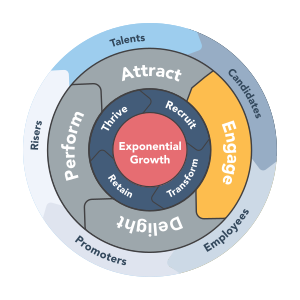
ENG (Engage)

Flywheel
profile-2user

LND (Learning & Development)

Target Audience
profile-2user

9 Departments: Executive, Leadership, R&D, Sales, Marketing, Customer Service, Operations, Field, Corporate Functions

Department Coverage
profile-2user

Employee Survey + Manager Survey (for triangulation)

Survey Versions
profile-2user

4 Universal + 6 Role-Specific = 10 competency areas per department

Competency Structure
profile-2user

Employees: 25–27 questions | Managers: 24–26 questions

Number of Questions
profile-2user

10–12 minutes (employees) | 10–12 minutes (managers)

Completion Time
profile-2user

30+ participants per department (representative sample required)

Minimum Participants
profile-2user

QuestionPro Online Platform (Side-by-Side Matrix)

Implementation Method
profile-2user

TR / EN (Multilingual survey)

Language Options
profile-2user

Training Priority Index (TPI) = GAP × Importance × Manager Coefficient

Scoring
profile-2user

IPA Matrix + Heatmap + Perception Gap + Department Top 5 + L&D Decision Summary + Strategic Training Plan

Reporting
profile-2user

Cross-department comparison + periodic re-audit (T1 vs T2)

Benchmark
profile-2user

Role-calibrated statements + Global Flagship modules (AI, Digital Transformation, Sustainability) + up to 2 additional custom competencies

Customization
profile-2user

Standard: Survey + Analysis + Report | Comprehensive: + Manager Survey + Perception Gap + Strategic Training Plan + Stakeholder Presentation

Package Scope
profile-2user

Project Manager

Included
profile-2user

Global Flagship modules (AI, Digital Transformation, Sustainability), Periodic Re-Audit (6–12 months), Training Plan Consulting, Budget Optimization

Optional Services
profile-2user

Learning Culture Index, Competency Gap Analysis, Learning Agility Index, Learning Experience Survey

Related Assessments
profile-2user

CON: Linking Learning to Talent Management and Performance, Increasing Training Efficiencies | PTP: Custom Training Programs | COA: Competency-Based Development Coaching

Related Products
profile-2user

Project-based (depending on the number of departments, organization size, and scope)

Pricing

Related Solutions 

magicpen Related Assessments
Learning Culture Index
Competency Gap Analysis
Learning Agility Index
Learning Experience Survey
Knowledge Transfer Assessment
L&D Academy Effectiveness
Show More
magicpen Related Training & Consulting
CON: Linking Learning to Talent Management and Performance, Increasing Training Efficiencies, Align L&D with Business KPI’s
PTP: Custom Training Programs, Data Literacy Fundamentals
COA: Competency-Based Development Coaching, Team Performance Coaching
SPK: Learning to Learn: The Only Skill That Doesn’t Expire
Show More

 Sales & Marketing Metrics 

Research data and statistics that can be used in the Training Needs Analysis sales process. Data already used in S2 and S6 has been excluded.

Training Investment & Budget Data
Corporate training expenditure in the United States (2025) (Training Magazine) → $102.8B
Average training spend per employee in 2025 (Training Magazine) →$874
Average annual training time per employee (2025) (Training Magazine) → 40 hours
Organizations plan to maintain or increase investment in career-focused learning (LinkedIn) →83%
Increase in external training spending — $16 billion (Training Magazine 2025) →+29%
Training Effectiveness Challenges
Insufficient training is a primary cause in 40% of employee resignations (SHRM) →40%
60% of first-time managers have never received management training (Gallup) →60%
Senior leaders report mid-to-advanced digital skills gaps (WEF) →68%
Employees’ core skills are expected to change between 2023–2027 (WEF) →44%
The biggest challenge for L&D is learner engagement (Training Magazine 2024) →29%
Positive Impact When Done Right
Companies with comprehensive training programs generate higher revenue per employee (Brandon Hall) →218%
Organizations with strong learning programs achieve higher profit margins (Brandon Hall) →24%
Employees whose careers are invested in stay longer (LinkedIn) →94%
Programs aligned with ROI measurement and KPIs increase customer satisfaction (ATD 2024) →15%
Reduction in new-hire ramp-up time after implementing TNA (industry average) →20%
Skills Gap & Future Workforce Data
Companies are experiencing or are aware of a skills gap (McKinsey) →87%
Projected workforce demand in the U.S. manufacturing sector (2024–2033) (Deloitte) →3.8M
HR professionals see finding qualified candidates as the biggest challenge (Breezy HR) →56%
HR professionals cite finding qualified candidates as their biggest challenge (Breezy HR) →74%
Employees are willing to learn new skills, but 54% lack sufficient opportunities (Ipsos) →25%