

target-icon-white
MOTG · Coaching for Behavioural Change · Flywheel

Coaching for Behavioral Change

focus-circle COA
profile LND
refresh-white PER — PERFORM
partner-white SP
depositphotos_317360989-stock-photo-confident-speaker-giving-public-presentation

Clarity replaces avoidance.

Trust grows, feedback lands, and the team starts telling the truth.
Leadership practice Premium Coaching
01

The challenge you face

Do any of these sound familiar?
After training, employees say “I understand.” Three weeks later, the same behavior persists. L&D teams see a “95% completion rate” in reports, but line managers say, “Nothing has changed.”
Employees know what they are expected to do, but cannot let go of old habits. They try new behaviors—but cannot sustain them.
Managers speak with employees, try to motivate them, set goals, and hold follow-up meetings. Sometimes they send them back to training again. Yet behavior still does not change.
This is not a knowledge problem. It is an execution problem. Because behaviour change does not come from knowledge, but from repetition + accountability — training provides knowledge, coaching changes behaviour.
Research Signal

70%

of behavioural change initiatives fail, according to McKinsey & Harvard Business Review.
— McKinsey & Harvard Business Review, 2024
vector
02

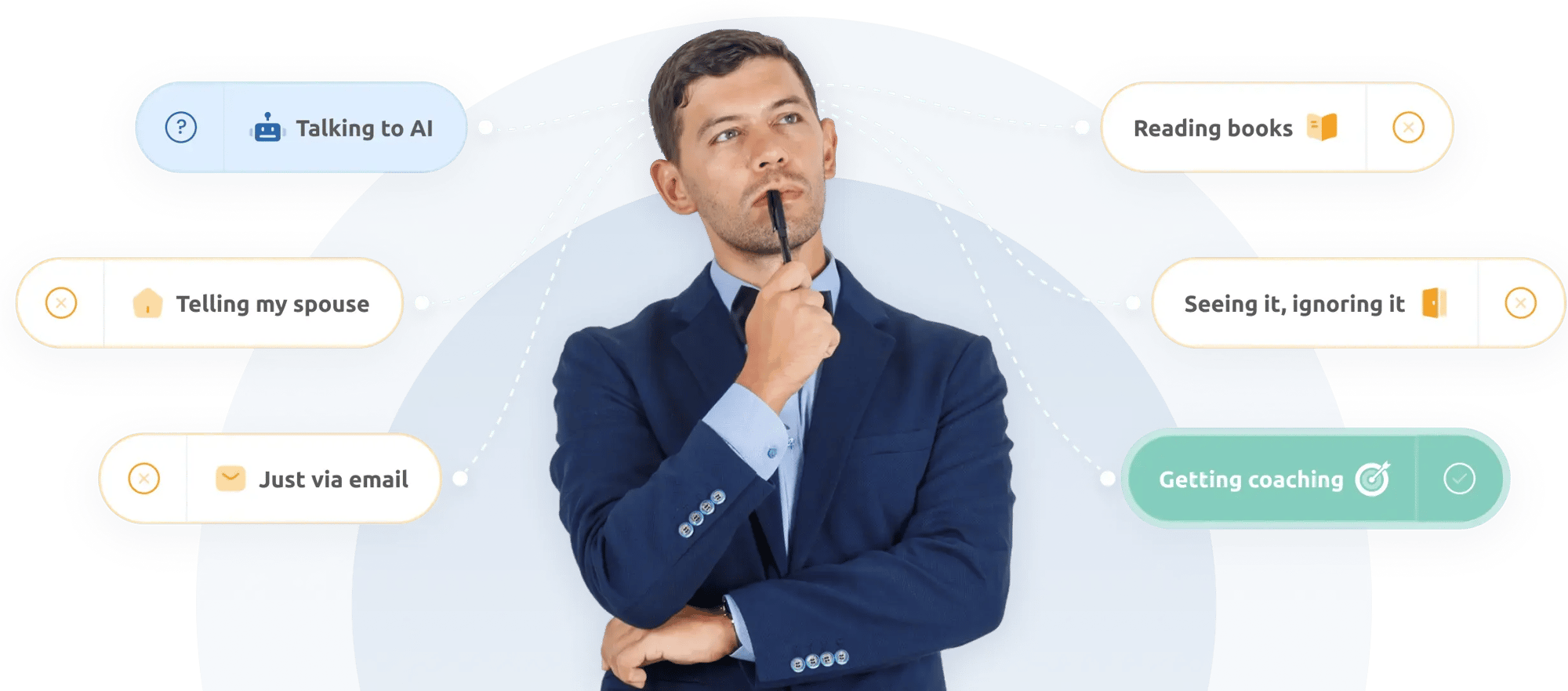
How Do You Overcome This Challenge?


overcome-challenge
sp-chatbot-small

SP — AI Coaching Tool

Hello! I'm SP, your AI Coaching tool.
AI + human coach
sp-chatbot-coach
Here’s what I can do:
  • green-tick-circle Help you outline the steps required for behavioural change
  • green-tick-circle Provide suggestions on techniques that may work
  • green-tick-circle Explain what to focus on during the behavioural change process
Here’s what I cannot do:
  • yellow-tick-circle Systematically track you through the behavioural change process
  • yellow-tick-circle Hold you accountable when you fall back into old habits
  • yellow-tick-circle Measure whether the behaviour change is truly sustainable

coaching-chances

AI is designed to satisfy you.

A coach is designed to develop you.
03

What Does This Coaching Do?

This coaching is for employees who have received training but have not changed their behaviour.
There is knowledge. There is awareness. But there is no execution.

There is knowledge. There is awareness. But there is no execution.

Employees know what to do, but cannot break their existing patterns.

This coaching breaks those patterns and turns knowledge into behaviour.

Who Is It For?

Managers -“My employee completed training but did not change behaviour. I want to learn how to coach effectively.”

Employees -“I know what to do, but I cannot do it. I want to break my old habits.”

L&D / HR -“Trainings are completed but behaviour does not change. How do we build coaching capability in managers?”

Behavioural change is no longer random—it becomes systematic.

depositphotos_429703630-stock-photo-employees-asking-questions-at-a

What Changes?

profile-tick-blue

In the Manager

Coaching capability develops. Instead of simply motivating employees, they learn to manage behavioural change systematically.
briefcase-pink

In the Organization

A learning culture is strengthened. Development shifts from knowledge accumulation to behaviour transformation.
profile-2user-yellow

In HR

Training ROI increases. Instead of completion rates, behavioural change becomes measurable.
buildings-green

In Employees

Old patterns are broken. New behaviours become sustainable. They are able to apply what they already know.
04

How Does It Work?

This coaching does not leave behavioural change to chance. It follows five steps:

01

Recognize

Identify which behaviour needs to change and why it is not changing. Stop externalising the problem.
02

Learn

Understand the skills required for behavioural change and make triggering moments visible.
03

Practice

Try new behaviours in a safe environment. Failure is normalised, and each attempt strengthens the next step.
04

Sustain

Maintain the new behaviour in difficult situations. Identify relapse moments and establish accountability.
05

Measure

Track whether real behavioural change is happening and make progress visible.
04

Process for Employees

You know what you need to do, but you cannot do it. This coaching follows five steps:  

01

Recognize

Understand what you should do and why you cannot do it. Face your own patterns.
02

Learn

Learn what is required for change and what triggers old habits.
03

Practice

Practice new behaviours in safe settings. Each attempt strengthens progress.
04

Sustain

Maintain new behaviours in challenging moments and prevent relapse.
05

Measure

Track your progress and identify where you struggle.
chart-1 Research context

In traditional approaches, managers often conduct “coaching” as motivational conversations.  

They say, “This is important for you,” set goals, hold follow-up meetings, and sometimes send employees back to training. These are all valuable efforts.

But most of the time, it stops there. 

Because motivational conversations provide information. Information does not change behaviour.  Employees already know what they should do. That is not the problem. The problem is: why does the same behaviour keep repeating?

This cannot be solved with motivation.

— McKinsey & Harvard Business Review

70%

of behavioural change initiatives fail

No information is delivered—patterns are broken.

The moment the employee avoids is identified. The trigger behind old behaviour becomes visible. New behaviour is supported by a system.

Behavioural change is not discussed. It is managed.


05

Tools & Package 

chart-white One-on-One Coaching Sessions
conversation-icon Behaviour Pattern Analysis
clipboard-text Real Case Work
book-green Accountability Systems
monitor-white Progress Tracking
Session duration
60 min
Program Duration
12 sessions
FORMAT
tick-circle-green In-Person
star Online
star Hybrid
Language
Turkish
English
Pre-work
tick-circle-green Target behaviour definition + current pattern analysis
Reporting
tick-circle-green Session summary + behavioural progress report
06

How Do You Get Started?

01

Get In Touch

Let us know you want to start.
02

Explore

We clarify together whether this is the right fit.
03

Decide

Approve your proposal and start the process.
04

Begin

Get matched with your coach and schedule your first session.
start-yourself profile

Start for yourself

Apply directly for behavioural change coaching.
leader-of-the-team buildings

Start for your team

As HR/L&D, request on behalf of employees.
07

Coaching Ends.
Development Doesn't.

Coaching does not end here. The real value is sustainability.

Behavioural change does not stop at the end of a coaching programme. To ensure new habits hold in real situations, old patterns do not return, and progress continues, post-programme support is available.

If you wish, you can support behavioural change in daily life through the following:

message-blue-icon

Mini Sessions

Short, focused support during critical moments or relapse situations
ai-coach-icon-pink

SP AI Coach

24/7 AI-powered coaching support for daily behavioural decisions
flash-yellow-1

Micro Learning

Reinforce new behaviours weekly in small doses to build lasting habits
graduation-cap-green

SP Premium Trainings

Advanced programmes in behavioural change, habit formation, and coaching skills

Ready to Transform Your Team's Productivity?

Take the next step with a free needs analysis meeting to see how GTD can work for your organization.

  • note-1 Pre-Assessment Available Crucial Skill Insights: Productivity Readiness Index
  • arrow-right Recommended Follow-up Power of Habit® · Crucial Conversations® for Accountability