







Leading High-Performance Teams Coaching
 COA
COA
 LEA
LEA
 PER — PERFORM
 SP
SP

Clarity replaces avoidance.
The challenge you face
Only 1 in 5 teams
The remaining 4 operate somewhere between “working” and “working well.”

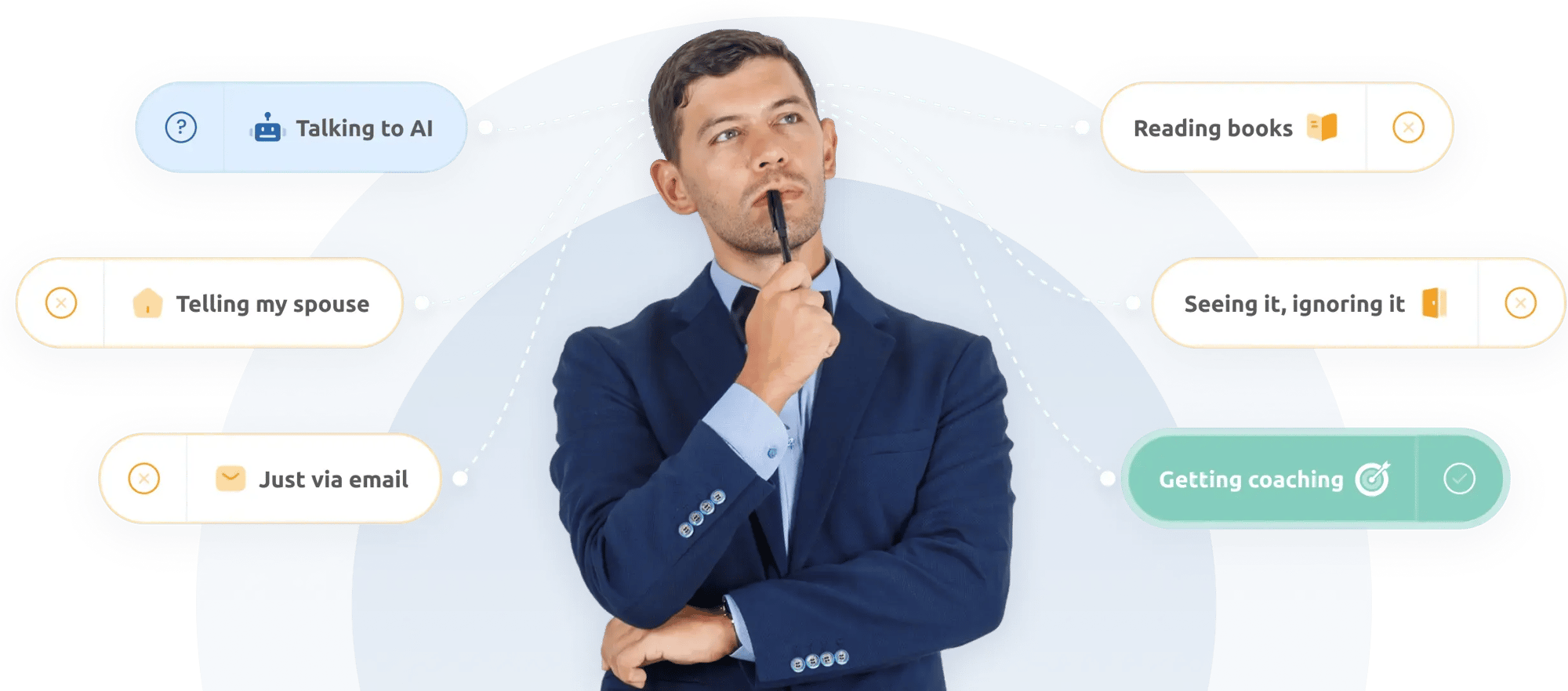
How Do You Overcome This Challenge?

SP — AI Coaching Tool
-
 Making role, responsibility, and collaboration gaps in your team visible
-
Providing clear frameworks and language alternatives for accountability conversations
-
Analyzing breaking points in your team system and preparing you for coaching
-
 Deeply track over time the inconsistencies between what you say and what you actually do
-
Reliably identify when you are justifying yourself, generalizing, or shifting focus
-
Stop you when you avoid difficult questions or redirect away from answers you already know
-
Create deep confrontations that truly challenge you by unpacking critical situations together
-
Continuously connect behavioral patterns over time to confront you with past decisions

Because high team performance is not about finding the right answers
What Does This Coaching Do?
It dismantles dysfunctional team structures created with good intentions and replaces them with a working system. It reduces coordination dependency and turns the team into an interconnected and accountable structure.
Who Is It For?
Leader • Team Manager • Department Head • C-Suite
For leaders who have capable individuals but cannot achieve results as a team, who experience clarity in meetings but fragmentation afterward, and who want accountability without it turning into pressure.
If the problem is not people — but results still do not come — this coaching is for you.

What Changes?

In the Leader

In the Organization

With Your Manager

In Employees
How Does It Work?
High-performing teams are not built by bringing good people together, but by changing how they work together.
 Research Context
Traditional coaching works with the leader. It builds awareness, asks powerful questions, and provides new perspectives. But it often does not translate into behavior.
Leaders understand what is wrong — but return to daily work and behave the same way because insight alone does not change behavior.
10–20%
The leader is coached — but the process does not stop at awareness.
Critical topics are opened and practiced. Difficult conversations are not delayed — they are executed. Decisions are followed through.
Behavior change is not left to chance. It is repeated, measured, and stabilized.
The leader becomes not only someone who knows what to do — but someone who sustains what they do.
Tools & Package
 One-on-One Coaching Sessions
 Team Dynamics Analysis
 Accountability Tracking
 Behavioral Observation Cycles
 Progress Reporting
 In-person
 Online
Hybrid
Session summary + behavior change tracking report
Team dynamics assessment + leader self-analysis
Online
Hybrid
Session summary + behavior change tracking report
Team dynamics assessment + leader self-analysis
How Do You Get Started?

Start for yourself


Start for your team leader
Coaching Ends.
Development Doesn't.
That’s why we don’t leave you alone after the process ends. If you wish, you can continue strengthening daily application through:

Mini Sessions

SP AI Coach

SP Micro Learning

SP Premium Trainings
Ready to Transform Your Team's Productivity?
Take the next step with a free needs analysis meeting to see how GTD can work for your organization.
-
 Pre-Assessment Available
Crucial Skill Insights: Productivity Readiness Index
Pre-Assessment Available
Crucial Skill Insights: Productivity Readiness Index
-
 Recommended Follow-up
Power of Habit® · Crucial Conversations® for Accountability
Recommended Follow-up
Power of Habit® · Crucial Conversations® for Accountability