







Building Performance Management System
“Are you managing performance — or just evaluating it?”
This consultancy is designed for organizations that, under the name of performance management, are in reality only conducting performance evaluations. In many companies, the performance process is limited to year-end reviews, subjective scoring, and goals that remain only on paper. Managers do not use the system in their daily decisions, employees do not clearly understand how they are evaluated, and performance results rarely translate into development. This consultancy transforms the goal-setting, feedback, evaluation, and development cycle into an integrated system — establishing a structure in which performance is truly managed and actively drives business results.
 Persona
 Project Duration
 Min. Days
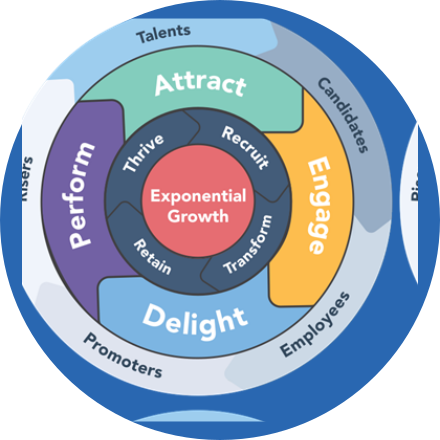
 Flywheel
 Partner
What Is It?
Building Performance Management System is a transformation consultancy designed for organizations where performance management has effectively been reduced to an annual evaluation process and where the goal–feedback–development cycle operates in a disconnected way.
In many organizations, performance is measured but not managed. The starting point of this approach is simple: evaluation is a tool, but managing performance is the real objective — and the two are not the same.
Within this consultancy: Organizational strategic priorities are clearly linked to individual and team goals, performance expectations are defined with measurable and understandable criteria and managers incorporate ongoing feedback and development coaching into their daily management practices. Performance data becomes not only a mechanism for evaluation but also a driver for development actions, career decisions, and talent management processes.

By the end of the consultancy
The organization will have a clear, consistent, and actively used system in place with full transparency regarding who is evaluated, the criteria used for evaluation, how the evaluation process is conducted, and which decisions are triggered as a result of those evaluations.

SWOT — Typical Organizational Profile
This represents the typical profile of organizations where performance management has effectively been reduced to an evaluation process.
STRENGTHS
 The performance evaluation process is defined and conducted regularly.
HR and managers are actively involved in goal setting.
Budget and time are allocated to performance and development.
Senior leadership recognizes the importance of performance, though systematic impact remains limited.
The performance evaluation process is defined and conducted regularly.
HR and managers are actively involved in goal setting.
Budget and time are allocated to performance and development.
Senior leadership recognizes the importance of performance, though systematic impact remains limited.
WEAKNESSES
 The process is compressed into the year-end evaluation; there is little or no ongoing feedback.
Individual goals are disconnected from strategic priorities.
Managers see performance management as an HR process rather than a leadership responsibility.
Performance outcomes do not influence development, promotion, or talent decisions.
Evaluation criteria are subjective; trust and transparency are weak.
Performance data does not flow into Learning, Career, and Reward systems.
The process is compressed into the year-end evaluation; there is little or no ongoing feedback.
Individual goals are disconnected from strategic priorities.
Managers see performance management as an HR process rather than a leadership responsibility.
Performance outcomes do not influence development, promotion, or talent decisions.
Evaluation criteria are subjective; trust and transparency are weak.
Performance data does not flow into Learning, Career, and Reward systems.
OPPORTUNITIES
 When PM is properly structured, promotion and compensation decisions become defensible.
When managers improve their coaching capability, team performance increases.
When strategy–goal–performance connections are established, execution quality improves.
A strong performance culture improves retention of high-potential employees.
When PM is properly structured, promotion and compensation decisions become defensible.
When managers improve their coaching capability, team performance increases.
When strategy–goal–performance connections are established, execution quality improves.
A strong performance culture improves retention of high-potential employees.
THREATS
 High performers who do not receive development feedback leave the organization.
In periods of economic pressure, organizations that cannot measure performance make poor decisions.
Gen Z and Millennials expect continuous feedback, making retention more difficult.
Weak performance management leads to productivity loss and poor talent decisions that ultimately create financial costs.
High performers who do not receive development feedback leave the organization.
In periods of economic pressure, organizations that cannot measure performance make poor decisions.
Gen Z and Millennials expect continuous feedback, making retention more difficult.
Weak performance management leads to productivity loss and poor talent decisions that ultimately create financial costs.
Who Is It For?
 Organizations that want to move performance management beyond the year-end review cycle and integrate it into managers’ daily leadership practices.
Organizations where goal setting, feedback, and evaluation exist but operate in disconnected processes and need to be integrated into a unified performance management system.
Leadership teams that recognize performance results are not systematically guiding promotion, development, and talent decisions.
Organizations where performance data does not flow systematically into Learning, Career, and Reward systems.
Organizations that want to move performance management beyond the year-end review cycle and integrate it into managers’ daily leadership practices.
Organizations where goal setting, feedback, and evaluation exist but operate in disconnected processes and need to be integrated into a unified performance management system.
Leadership teams that recognize performance results are not systematically guiding promotion, development, and talent decisions.
Organizations where performance data does not flow systematically into Learning, Career, and Reward systems.
 Organizations without defined role and competency frameworks — a performance system cannot be built without this foundation. (Priority: CON-10)
Organizations that believe performance problems can be solved solely through software or automation — this requires a system and behavior transformation.
Organizations whose leadership teams are not willing to actively own performance management.
Organizations that treat performance management as an HR process conducted only at the end of the cycle rather than a continuous leadership practice.
Organizations without defined role and competency frameworks — a performance system cannot be built without this foundation. (Priority: CON-10)
Organizations that believe performance problems can be solved solely through software or automation — this requires a system and behavior transformation.
Organizations whose leadership teams are not willing to actively own performance management.
Organizations that treat performance management as an HR process conducted only at the end of the cycle rather than a continuous leadership practice.
What You Gain?
A System Where Performance Is Managed
A Real Link Between Strategy and Execution
Data-Driven Talent Decisions
Manager Role Transformation
Integrated Talent Management
Trust and Clarity
The Numbers

2%

3.6x

74%
Value Timeline

Working Model
Performance Reality

System Design

Manager Activation

Behavior & System Sustainability

Performance Reality

System Design

Manager Activation

Behavior & System Sustainability
How We Work

We Start with Data
We move forward based on real usage data, not assumptions. We look not at whether the system exists, but at how managers actually use it—what decisions rely on which data and where breakdowns occur. This allows the true performance reality to become clearly visible.

We Build It Together
The performance management model is not created from a ready-made template. Instead, it is co-designed based on the organization’s own management reality. The goal is not simply to build a system, but to establish a management practice that managers will genuinely use.

We Progress Through Real Practice
The process does not take place in meeting rooms but through real manager–employee interactions. Feedback, performance conversations, and decision processes are tested in real settings, implemented in practice, and embedded sustainably.

We Design for Actual Use
We do not change the existing system infrastructure. Platforms such as SAP SuccessFactors or similar systems remain in place. Our focus is on establishing the managerial behaviors and decision mechanisms that ensure these systems are actively owned and used by managers.

An Independently Sustainable Structure
When the consulting engagement ends, what remains is not just the system but the behaviors. Managers take ownership of performance management, and the structure continues to function sustainably without requiring external support.
Common Objections

“We already have a performance system; we use SAP SuccessFactors.”
“Our managers already conduct performance conversations.”
“We conduct our performance evaluations regularly.”
“This is an HR project; it is difficult to involve business units.”
“It’s not a priority right now; we are too busy.”
“Our own HR team can handle this.”

“We already have a performance system; we use SAP SuccessFactors.”
“Our managers already conduct performance conversations.”
“We conduct our performance evaluations regularly.”
“This is an HR project; it is difficult to involve business units.”
“It’s not a priority right now; we are too busy.”
“Our own HR team can handle this.”
Our Approach

We Activate Managers, Not Systems

We Move Forward Through Diagnosis

We Prioritize Behavioral Change Before System Change
Trusted Technology and Consulting Partners

Prerequisites For Success
This consulting engagement produces real value only when these conditions are met. Otherwise, the process may progress, but lasting results will not emerge.

Executive Sponsorship

Facing Reality with Clarity

Implementation Focus

Time and Focus Commitment
Related Solutions
 CON
CON
Managing Competency Framework
A foundational prerequisite for a performance management system. Performance criteria cannot be established without defining role-based competency expectations.
 CON
CON
Linking Learning to Talent Management and Performance
Connects development needs identified in the performance process with L&D processes, converting PM system data into actionable outcomes.
 CON
CON
Implementing Motivation Framework
Adds a motivation dimension to performance management and helps managers conduct more effective performance conversations.
 PTP
PTP
Crucial Conversations for Accountability
Enables managers to conduct feedback and performance conversations effectively, supporting manager activation.
 CON
CON
Implementing 360 Feedback
Introduces a multi-perspective view into performance evaluations, producing more objective and richer data.
 COA
COA
Execution & Accountability Coaching
Supports the implementation of performance goals at the individual level and strengthens accountability.
 SaaS
SaaS
Performance & Learning Enablement Platform (Bridge LMS)
A complementary digital platform that supports the daily use of performance and development processes and integrates with existing systems.
Overview

General Overview
 Target Persona
 Project Duration
 Minimum Consulting Days
 Language
What's Included?
-
 On-siteRecommended
 -
Live Remote
-
Hybrid
-
Pre-AssessmentAvailable (Current PM Data)
-
AssessmentPerformance Assessment, 360 FeedbackOptional
-
Project Management PlatformAvailable
-
Executive/Sponsor MeetingAvailable
-
ReportingAvailable
-
Supporting ResourcesAvailable
-
 E-LearningOptional
 -
Microlearning
-
Workshop
-
Implementation SupportOptional
 Recommended Training
Crucial Conversations for Accountability
-1.png?width=500&height=500&name=Gemini_Generated_Image_xv33d4xv33d4xv33%20(1)-1.png)