







Linking Learning to Talent Management and Performance
"Are L&D Processes Designed Around Competency Gaps?"
This consultancy integrates role-based competency expectations, performance management, and learning processes to move learning beyond a standalone activity. The goal is for competency gaps identified in the performance process to systematically flow into L&D processes, for employees to be directed toward targeted learning paths based on their needs, and for development to be measured and connected to performance and career decisions.
Overview
 Persona
 Project Duration
 Min. Consulting Days
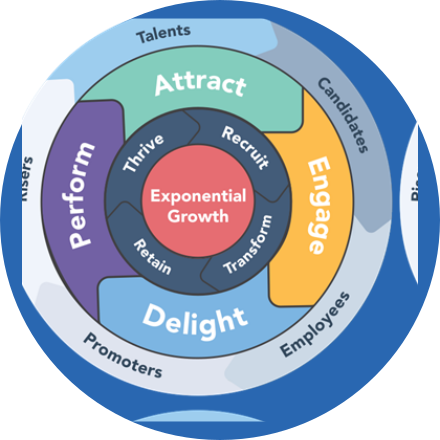
 Flywheel
 Partner

What Is It?
Linking Learning to Talent Management and Performance
Linking Learning to Talent Management and Performance is an infrastructure setup consultancy that eliminates the structure in which learning activities progress independently from performance and competency needs — bringing these processes together under a single system. The core approach is for learning to be triggered not by individual preferences, but by competency gaps that emerge during the performance process.

In this system:
Role-based competency expectations serve as the reference; during the performance process, the degree to which employees meet these expectations is assessed, and the gaps that form are defined as development areas. These areas are directly transferred to L&D processes and employees are directed to learning paths designed around their needs. The process is tracked through interim reviews and measurements with the manager; development outputs are reflected in performance results and career decisions (promotion / reward).

SWOT — Typical Organization Profile
This is the typical profile of organizations in which L&D activities progress disconnected from performance and competency management.
STRENGTHS
 Performance management and L&D processes are defined and operational
The organization allocates budget and resources for employee development
Role and job descriptions exist (foundational structure in place, though depth may be limited)
Leadership positions talent development as a strategic priority
Performance management and L&D processes are defined and operational
The organization allocates budget and resources for employee development
Role and job descriptions exist (foundational structure in place, though depth may be limited)
Leadership positions talent development as a strategic priority
WEAKNESSES
 Competency gaps identified in the performance process are not flowing into L&D processes
Training planning is shaped by catalogs and individual preferences, not real development needs
L&D, performance, and career processes run in parallel; they don't feed each other
Employees don't know which competencies to develop to advance to which role
The impact of learning activities on performance output is not being measured
Competency gaps identified in the performance process are not flowing into L&D processes
Training planning is shaped by catalogs and individual preferences, not real development needs
L&D, performance, and career processes run in parallel; they don't feed each other
Employees don't know which competencies to develop to advance to which role
The impact of learning activities on performance output is not being measured
OPPORTUNITIES
 The shift to competency-based development models is making internal talent development a strategic advantage
Existing performance and L&D data can be integrated to generate rapid value
Connecting learning investments to business outcomes elevates the L&D function's impact within the organization
Critical positions can be filled with internally developed talent
The shift to competency-based development models is making internal talent development a strategic advantage
Existing performance and L&D data can be integrated to generate rapid value
Connecting learning investments to business outcomes elevates the L&D function's impact within the organization
Critical positions can be filled with internally developed talent
Threats
 When learning and performance are disconnected, L&D investments are seen as cost without value generation
Employees without a clear career path look outside the organization
Talent loss accelerates as competitor organizations build integrated development systems
Performance improvement remains limited in employees not directed based on development needs
When learning and performance are disconnected, L&D investments are seen as cost without value generation
Employees without a clear career path look outside the organization
Talent loss accelerates as competitor organizations build integrated development systems
Performance improvement remains limited in employees not directed based on development needs
Who It's For / Who It's Not For
 Organizations that see development areas being defined in the performance process but this information not flowing into L&D processes
L&D and Talent Management leaders who recognize that training planning is still shaped by catalogs and individual preferences
Structures that cannot measure the impact of learning investments on performance output and want to make this connection
Organizations that want to clarify which competencies employees need to develop to advance to which role
Structures that want to integrate performance, learning, and career processes under a single system
Organizations that see development areas being defined in the performance process but this information not flowing into L&D processes
L&D and Talent Management leaders who recognize that training planning is still shaped by catalogs and individual preferences
Structures that cannot measure the impact of learning investments on performance output and want to make this connection
Organizations that want to clarify which competencies employees need to develop to advance to which role
Structures that want to integrate performance, learning, and career processes under a single system
 Organizations where role and competency architecture is not yet defined — Priority: Managing Competency Framework (CON-10)
Structures where the performance management process is not operational — A system that produces no development areas cannot be fed
Organizations not ready to build integration between L&D and Talent/HR teams
Structures not aiming to reflect learning outcomes in performance and career decisions
Organizations where role and competency architecture is not yet defined — Priority: Managing Competency Framework (CON-10)
Structures where the performance management process is not operational — A system that produces no development areas cannot be fed
Organizations not ready to build integration between L&D and Talent/HR teams
Structures not aiming to reflect learning outcomes in performance and career decisions
What Do You Gain?
Performance–Learning Integration
Role-Based Targeted Learning
Measurable Development & Impact
Clarified Career Path
Manager-Led Development Tracking
Strategic L&D Positioning
The Numbers

60%

4%
20% / 15%
Value Timeline
ANALYZE
DESIGN
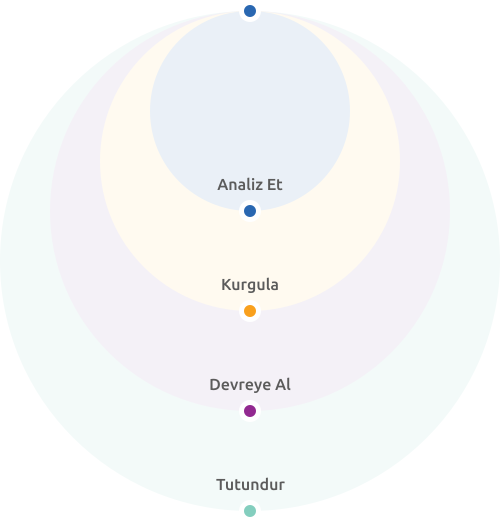
DEPLOY
SUSTAIN
Working Model





Current System Mapping
Integrated Model Design
End-to-End Operation
Impact & Sustainability
Current System Mapping
Integrated Model Design
End-to-End Operation
Impact & Sustainability
How We Work

We Start with Data
We don't move to design without analyzing performance data, competency gaps, and L&D metrics. Where development needs arise and why this information isn't flowing into L&D (or why it is) is clarified.

We Think Integrated
We don't treat performance, learning, and career processes separately; we design all three to operate within a single flow.

We Build Together
We don't apply a ready-made model; we design together with teams based on the organization's existing performance cycle, role structure, and L&D reality.


We Align Stakeholders
We bring L&D, Talent Management, and manager teams into the same flow. Processes don't run separately; they operate as a single system.

Fast Feedback Loop
The learning process doesn't progress disconnected from the performance cycle; it is continuously tracked through interim reviews and measurements, with real-time improvements made.

Independently Manageable Structure
The system built operates on its own within the organization after the consultancy; it becomes reproducible and sustainable in every performance cycle.

Common Objections


"Defining skill gaps for each individual employee is very difficult."
 Answer
"Managing a separate learning path for everyone is very difficult — we have thousands of employees."
Answer
"Our L&D team is already active — we deliver a lot of training."
Answer
"Measuring the impact of learning on business outcomes is difficult."
Answer
"Our L&D team is already doing skill development."
Answer
"We don't clearly know which skills our employees need."
Answer
"Managing this much integration within the organization is difficult."
Answer

Our Approach

We See Learning as an Output of Performance

The Data Already Exists — We Build the Flow

We Focus on the System, Not the Training
Prerequisites For Success
This consultancy produces real value only when these conditions are met. Otherwise the process moves forward, but no lasting result is formed.

Senior Leadership Ownership

Leadership & Stakeholder Alignment

Decision-Making & Execution Discipline

Execution Focus
Related Solutions
 CON
CON
Managing Competency Framework
The infrastructure prerequisite for this consultancy. Without defining role-based competency expectations, performance–learning integration cannot be built.
 CON
CON
Aligning Talent Management with Learning Initiatives
Aligns L&D initiatives with the talent management strategy; the strategic upper layer of the CON-06 system.
 CON
CON
Building Performance Management System
Builds the performance management infrastructure. CON-06 is fed by the gap data this system produces; the two consultancies reinforce each other.
 ASS
ASS
Competency Gap Analysis
Compares employees' current competency levels with role expectations; forms the input for the CON-06 system.
 COA
COA
Competency-Based Development Coaching
Coaching that converts competency gaps into individual development goals; the individual application arm of the CON-06 system.
 SAS
SAS
LMS Solution (Bridge LMS)
The platform on which learning paths generated from performance gaps are managed and tracked; the technology leg of the CON-06 infrastructure.
Overview

General Overview
 Target Persona
 Project Duration
 Min. Consulting Days
 Language
What's Included?
-
 In-PersonRecommended
 -
Live Remote
-
Hybrid
-
Pre-AnalysisExisting Data
-
 AssessmentOptional
 -
Project Management
-
Manager Interview
-
Reporting
-
Implementation Support
-
PartnerSP
-
FlywheelDELIVER
-
E-LearningOptional
-
Micro LearningOptional
-
WorkshopOptional
 Recommended Training
Crucial Conversations for Accountability
.png?width=2000&height=2000&name=Gemini_Generated_Image_xv33d4xv33d4xv33%20(1).png)