







DID YOU
KNOW?
 McKinsey, "Superagency in the Workplace" — January 2025
So Where Is the Problem?
Approximately 70% of the challenges in AI implementation stem from people and processes, 20% from technology, and only 10% from algorithmic issues.

70%
People & Process
Source of Challenges in AI Implementation

20%
Technology

10%
Technology


AI is not simply a technology initiative — it is a change management initiative. Many leaders are still unaware of this and of the role they must play in the transformation.
"Where's the Value in AI?" — October 2024
BCG
Common Problems Many Organizations Face
When leaders are not prepared, organizations face four interconnected challenges:


Pilot Hell — AI Projects Fail to Scale Leaders initiate AI projects, allocate budgets, and build teams — yet the leadership capacity required to guide transformation is missing. Pilots appear successful but never move into production. Dozens of projects run simultaneously without producing results. The organization becomes trapped in “pilot hell.”95% of enterprise AI pilots produced no measurable financial outcomes 42% of companies abandoned AI projects — up from 17% in 2024MIT, 2025 | S&P Global, 2025
Pilot Hell — AI Projects Fail to Scale Leaders initiate AI projects, allocate budgets, and build teams — yet the leadership capacity required to guide transformation is missing. Pilots appear successful but never move into production. Dozens of projects run simultaneously without producing results. The organization becomes trapped in “pilot hell.”95% of enterprise AI pilots produced no measurable financial outcomes 42% of companies abandoned AI projects — up from 17% in 2024MIT, 2025 | S&P Global, 2025


AI Theater — Visibility Without Transformation Boards announce AI initiatives, showcase prototypes, and release press statements. However, strategic AI decisions are not made because many executives lack sufficient understanding of the topic. This creates the appearance of AI adoption without real transformation. 66% of board members say they have little or no knowledge about AI Only 17% of board members say they have little or no knowledge about AI
AI Theater — Visibility Without Transformation Boards announce AI initiatives, showcase prototypes, and release press statements. However, strategic AI decisions are not made because many executives lack sufficient understanding of the topic. This creates the appearance of AI adoption without real transformation. 66% of board members say they have little or no knowledge about AI Only 17% of board members say they have little or no knowledge about AI



Only 17% discuss AI at every board meeting. Employees explore AI, use it, and see its benefits. But without leadership support, adoption slows. 55% of employees feel positive about AI when leadership support exists. Without leadership support, the rate drops to 15%. Only 1 in 4 employees report receiving leadership support. BCG AI at Work, 10,600+ employees, 11 countries, 2025
Only 17% discuss AI at every board meeting. Employees explore AI, use it, and see its benefits. But without leadership support, adoption slows. 55% of employees feel positive about AI when leadership support exists. Without leadership support, the rate drops to 15%. Only 1 in 4 employees report receiving leadership support. BCG AI at Work, 10,600+ employees, 11 countries, 2025


BCG AI at Work, 10,600+ employees, 11 countries, 2025Leaders often delegate AI projects to IT teams, pushing change management to the background. Yet AI transformation is not purely technical — it is fundamentally human. %31 of the workforce will require reskilling within the next three years. IBM CEO Study, 2,000 CEOs, 33 countries, 2025
BCG AI at Work, 10,600+ employees, 11 countries, 2025Leaders often delegate AI projects to IT teams, pushing change management to the background. Yet AI transformation is not purely technical — it is fundamentally human. %31 of the workforce will require reskilling within the next three years. IBM CEO Study, 2,000 CEOs, 33 countries, 2025
Pilot Hell — AI Projects Fail to Scale Leaders initiate AI projects, allocate budgets, and build teams — yet the leadership capacity required to guide transformation is missing. Pilots appear successful but never move into production. Dozens of projects run simultaneously without producing results. The organization becomes trapped in “pilot hell.”95% of enterprise AI pilots produced no measurable financial outcomes 42% of companies abandoned AI projects — up from 17% in 2024MIT, 2025 | S&P Global, 2025
AI Theater — Visibility Without Transformation Boards announce AI initiatives, showcase prototypes, and release press statements. However, strategic AI decisions are not made because many executives lack sufficient understanding of the topic. This creates the appearance of AI adoption without real transformation. 66% of board members say they have little or no knowledge about AI Only 17% of board members say they have little or no knowledge about AI
Only 17% discuss AI at every board meeting. Employees explore AI, use it, and see its benefits. But without leadership support, adoption slows. 55% of employees feel positive about AI when leadership support exists. Without leadership support, the rate drops to 15%. Only 1 in 4 employees report receiving leadership support. BCG AI at Work, 10,600+ employees, 11 countries, 2025
BCG AI at Work, 10,600+ employees, 11 countries, 2025Leaders often delegate AI projects to IT teams, pushing change management to the background. Yet AI transformation is not purely technical — it is fundamentally human. %31 of the workforce will require reskilling within the next three years. IBM CEO Study, 2,000 CEOs, 33 countries, 2025
The Hidden Costs Of These Problems

Performance Cost
Projects fail. Without leadership direction, AI initiatives cannot scale and investments are wasted. 95% of enterprise AI pilots produced no measurable financial results (MIT, 2025) 42% of companies abandoned AI projects (S&P Global, 2025)

Cultural Cost
Organizations fall behind in AI transformation. When transformation begins without leadership readiness, teams experience fear, distrust, and resistance. The question “Will AI replace my role?” remains unanswered. Lack of transparent communication fuels passive resistance. 91% of data leaders say culture is the biggest barrier to AI adoption MIT Sloan, 2025

Strategic Cost
Companies fall behind in markets, competition, and changing customer expectations. 94% of companies face a critical AI talent gap (WEF, 2025). Organizations with strong AI leadership achieve 3.2× higher profit margins (McKinsey, 2025). Companies that fail to invest in leadership may never close this gap.
If These Problems Continue
If leaders do not become capable of managing AI transformation and instead learn through trial and error:
First 90 Days — AI Becomes an IT Project
At first, everyone assumes, “AI technology → the CTO will handle it.” Then the following happens: the AI platform is implemented, a data lake is built, problems are selected, models are developed, and a few demos are presented. However, business decisions remain unchanged. As a result, AI becomes a technology showcase rather than a true transformation.
6–12 Months — The Use Case Graveyard
Data and model quality problems begin to emerge. A typical scenario unfolds: 40–50 AI use cases are identified, 5–10 pilots are launched, and only 1–2 ever reach production deployment. The return on investment remains unclear, context is often missing, and the operational impact is questionable. Over time, passive resistance starts to surface: “AI will take our jobs,” or “We were never consulted.” As a result, adoption declines. In the literature, this phenomenon is often referred to as the “AI pilot graveyard.” Ultimately, the problem is not technology — it is people and leadership.

2–3 Years — The Classic Scenario
The CEO asks: “We invested $30 million. What exactly did AI deliver?” The answer often includes a few chatbots, a few dashboards, and some automation. Two outcomes typically follow. First, AI fatigue sets in and projects are gradually stopped. Second, a reset occurs, where a new leader reframes the situation by stating: “This is not a technology project. It is a management transformation.”
What Competency Is Needed To Solve This?

AI Collar Worker
Leadership in the AI era is the ability to build systems in which human employees and AI-powered digital workers collaborate, significantly increasing organizational learning speed, decision quality, and execution capability.
What Is This Program?
"We may be in the last era where leaders manage only humans. From now on, leaders who manage human + AI teams will make the difference."
The Leadership in the AI Era Program is a two-day intensive and practical corporate transformation module designed for executives who want to successfully transform their organizations in the age of artificial intelligence. The program treats AI not as a technical topic but as a strategic leadership responsibility.
Each participant: Compares their leadership role with the requirements of the AI era, Develops new skills for human-AI hybrid teams, Gains practical tools for implementation. By the end of the program, participants leave with: A 30-day action plan and A personal leadership roadmap
What Will You Learn?
#
 Themes
 Workshops
1
AI-Era Leadership Competencies
Curiosity · Judgment · Problem Solving · Data Fluency · Evaluation Literacy · Experimentation Mindset · AI Agent Management
2
Redesigning Roles and Team Structures
AI Ops · Super Orchestrators · Super Contributors · AI Agent Leadership · Impact-based leadership model
3
AI Investment & ROI Strategy
Hypothesis → Test → Learn cycle · Identifying value areas · Prioritization · Leadership decision points
4
Managing Trust and Fear
Role anxiety · Communication framework for “Will it replace my job?” · Creating safe experimentation environments
5
Balancing Speed and Responsibility
Responsible speed principles · Guardrail model · Pilot design · Risk management
6
Strategic Value of Human Skills
Empathy · Storytelling · Creative thinking · Human + AI decision processes
7
Experimentation and Learning Culture
Rapid learning · Experiment teams (pods) · Learning from failure culture
Learning Outcomes
AI-Era Leadership Capability
Leaders who develop this capability guide their organizations through AI transformation step by step — moving from experimentation to Agentic AI structures, and ultimately to an AI-Ready organizational model.

Learn faster
Make higher-quality, data-driven decisions
Execute faster and achieve stronger results
Increase productivity through collaboration between human and AI-collar workers
Strengthen innovation and new business model development capability
Build a transparent and strong culture of accountability across the organization
Achieve sustainable competitive advantage through rapid adaptation to change
Who Is It For?
 Suitable For
Organizations that view AI transformation as a change management initiative
Companies capable of integrating data, people, processes, culture, and technology
Organizations mentally open to adaptation and change
Growth-oriented organizations
Companies that make decisions based on data rather than perception
Companies that have invested in AI but cannot move to production and want to escape pilot hell
CHROs / CLOs who want to systematically upgrade leadership capabilities for the AI era
 Not Suitable For
Organizations that see AI transformation as just another trend
Companies that view AI transformation purely as an IT project
Organizations without leadership buy-in and executive sponsorship
Status-quo-focused management cultures
Companies that are not data-driven
Organizations resistant to AI (e.g., viewing it as a bubble or temporary trend)
 Urgent
Why Now?

Employees are ready — leaders are not:
McKinsey’s January 2025 report states clearly: the biggest barrier to AI adoption is not employee resistance but the inability of leaders to guide transformation quickly enough.
Technology is no longer the bottleneck:
According to OpenAI’s State of Enterprise AI 2025 report, the primary constraint is organizational readiness, not model performance or tools.
The gap is widening:
BCG (2025) reports that companies investing in AI leadership generate 3.6× higher shareholder returns than lagging competitors.
The window is closing:
Leaders who manage AI transformation early establish lasting organizational advantages. Technology will eventually become accessible to everyone — but leaders who know how to manage it effectively will always remain scarce.
The direction of change has reversed:
Employees using AI are creating high impact independently of traditional hierarchies. Role definitions are being rewritten globally. If leaders fall behind, erosion of authority becomes inevitable.
Investments are being wasted:
42% of companies abandon AI projects before moving them into production (S&P Global, 2025), and 84% of AI failures are leadership-related (RAND, 2024). Both data points point to the same conclusion.
ROI has been proven:
Companies with strong AI leadership achieve 3.2× higher profit margins (McKinsey, 2025). This difference is explained not by technology, but by leadership quality.
The talent war:
High-potential employees prefer companies with an AI-first culture. Leaders who internalize AI leadership both attract top talent and retain them.
Customer Voice
"After the Leadership in the AI Era program, we clearly saw what needed to change within our team. We are no longer leaders who manage AI — we are a team that leads with AI. The 30-day action plan developed during the workshops turned abstract discussions into concrete steps. Within two months, we moved one of our pilot projects into production."
—Chief Transformation Officer
Industrial Sector
Related Solutions
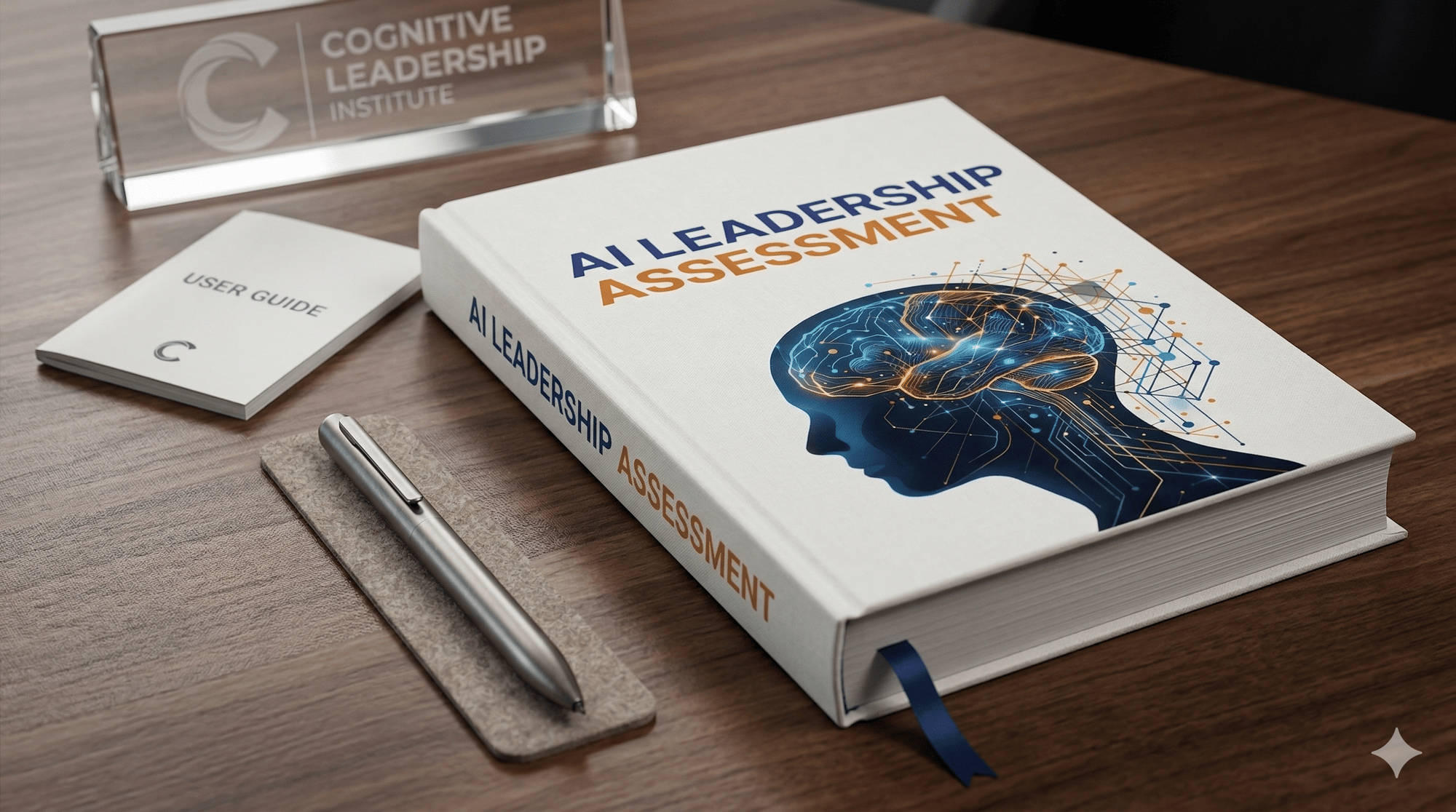 Assessment | AIA · LEC
AI Leadership Assessment
AI leadership capability profile — 5 dimensions, 40 questions. Can be used before or after training.
 Assessment | RESC · LCH
Change Readiness Assessment
Measures organizational readiness for AI transformation and identifies resistance in advance.
 Premium Training | LEC · RESC
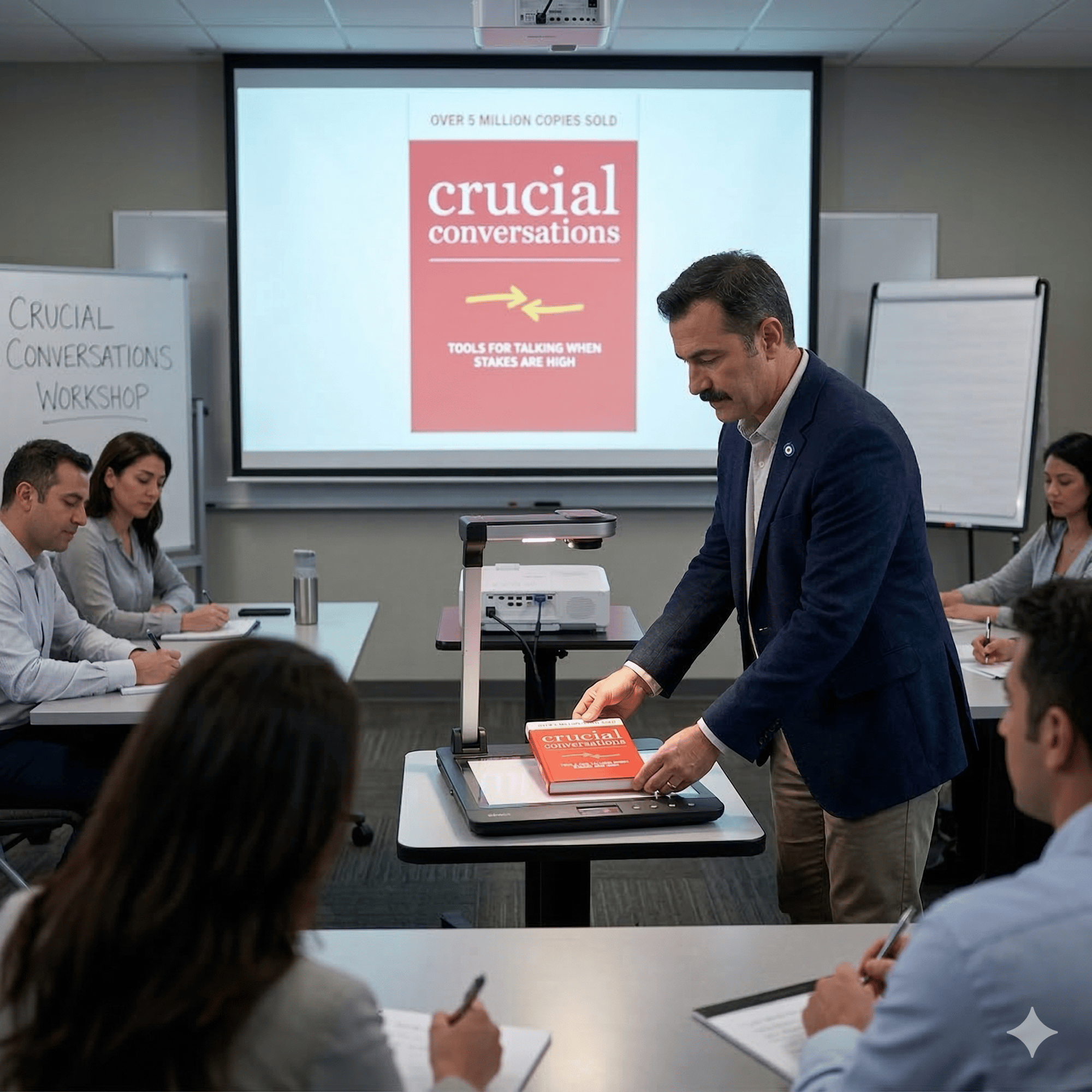
Crucial Influence®
Addresses behavior change through six sources of influence. A natural continuation program ensuring sustainable AI adoption within teams.
Program Details

AI Programme | aiprogramme.ai
Partner
Leadership in the AI Era Program
Product Name
AIA | LEC | STRG | GROC | RESC | LERG
Challenge Codes
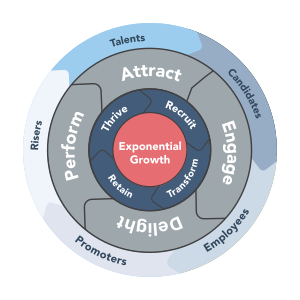
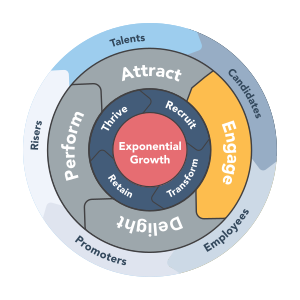
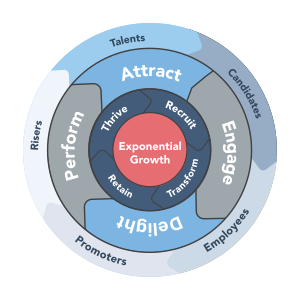
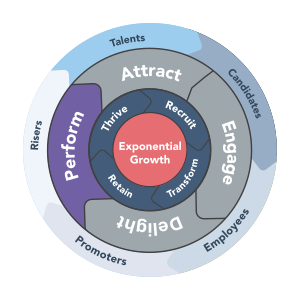
PERFORM
Flywheel
C-Level Executives, Directors, Mid-Level Managers, Team Leaders, AI Project Sponsors, HR / L&D / Transformation Teams
Target Audience
Min 8 — Max 16
Participants
2 Days
Duration
In-Person · Live Online
Delivery Format
TR / EN
Language Options
Pre-Assessment
Optional
Customization
Optional
AI Leadership Insight (5 Dimensions, 40 Questions) — Optional
Assessment Tool
Customization
Optional
Training Kit
Available
Gamification
Available
Certificate
Available
Awards
Available
Post-Training Reinforcement
Optional
Additional Resources
Available
Post-Training Reinforcement
Optional
AIA-PTP-M2AL-AIP-AWP-CTO-AIW-PER-079
SKU
Crucial Influence® · Data Literacy for Leaders
Follow-Up Programs