

SOCIAL STYLE® Training

What is the annual cost to your organization when teams misunderstand each other, salespeople misread customer communication styles, and managers fail to see their own communication blind spots?

Most organizations have never calculated it—because no one makes this cost visible.

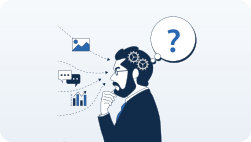
What you think about yourself and how others perceive you are not the same.

flash-yellow
flash-yellow

DID YOU
KNOW?

training-data-vector

%65

In a study of 6,000 participants, 65% of managers say they communicate well with their teams — but their teams disagree.

Only 35% of employees can accurately predict their own Versatility score from their colleagues’ perspective. In other words, two out of three people are unaware of how others perceive them.


Common Problems Many Organizations Face

The effects of this blind spot differ by role:

no-systematic-work management no-systematic-work management-hover
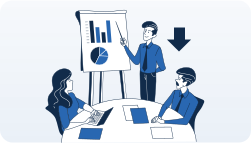
Managers — Misunderstood Without Realizing It. A manager who says “I’m direct and straightforward” may be perceived as aggressive by an Amiable team member. An Analytical leader who says “I provide detailed explanations” may be interpreted as “not trusting me” by a Driving employee. The intention may be good — but the impact can be destructive. Because in communication, what matters is not what you say, but what the other person hears.
decisions-in-metting decisions-in-metting-hover
Sales Teams — Using the Same Approach for Every Customer. Salespeople sell in their own style. An Expressive salesperson may enthusiastically present while an Analytical customer expects data. A Driving customer wants speed, while the salesperson explains process steps.
organization-2
busy-people busy-people-hover
Leadership Teams — Unable to See Their Own Blind Spots. There is often a significant gap between how leaders evaluate themselves and how their teams evaluate them.
peoples-head peoples-head-hover
HR & L&D — Training Investments Do Not Translate into Behavior 360° feedback processes are conducted, but results often stop at “this is how you are” without teaching what to do differently. Coaching programs focus on understanding one’s own style rather than how to work with others.
no-systematic-work management no-systematic-work management-hover
Managers — Misunderstood Without Realizing It. A manager who says “I’m direct and straightforward” may be perceived as aggressive by an Amiable team member. An Analytical leader who says “I provide detailed explanations” may be interpreted as “not trusting me” by a Driving employee. The intention may be good — but the impact can be destructive. Because in communication, what matters is not what you say, but what the other person hears.
decisions-in-metting decisions-in-metting-hover
Sales Teams — Using the Same Approach for Every Customer. Salespeople sell in their own style. An Expressive salesperson may enthusiastically present while an Analytical customer expects data. A Driving customer wants speed, while the salesperson explains process steps.
busy-people busy-people-hover
Leadership Teams — Unable to See Their Own Blind Spots. There is often a significant gap between how leaders evaluate themselves and how their teams evaluate them.
peoples-head peoples-head-hover
HR & L&D — Training Investments Do Not Translate into Behavior 360° feedback processes are conducted, but results often stop at “this is how you are” without teaching what to do differently. Coaching programs focus on understanding one’s own style rather than how to work with others.

The Hidden Costs Of These Problems

trend-down-1

Operational Cost

According to The Myers-Briggs Company (2022), employees spend an average of 4.34 hours per week managing conflict, and in some cases up to 16 hours per week .37% of workplace conflicts arise from personality differences. This equals approximately $8,700 per employee per year in time cost alone. But the real cost is deeper: lower job satisfaction, declining sense of belonging, and increased stress — silently eroding organizational health. The Myers-Briggs Company — Conflict at Work, 2022

profile-2user-white

Cultural Cost

The label “difficult person” is often not a personality problem but a misinterpretation of communication style. Conflict frequently results in damaged relationships, loss of trust, and collapse of collaboration. Misunderstood employees withdraw, fail to demonstrate their potential, or eventually leave the organization. Over time, a culture emerges that cannot tolerate different styles — a system that continuously consumes talent. The Myers-Briggs Company — Conflict at Work, 2022

strategic-outcome

Strategic Cost

Organizations unable to adapt to different communication styles also make flawed strategic decisions. Leaders listen, evaluate, and promote people based on their own style. Only similar voices are heard in meetings, while diverse perspectives disappear. The result: blind-spot strategies, decisions made with incomplete information, and missed opportunities. TRACOM Group — Social Intelligence Research, 2024

If These Problems Continue

If people cannot understand each other’s communication styles and fail to develop adaptability:

early-signals
10 Days

A new employee with an Analytical style joins the team. They remain quiet in the first meeting because analytical individuals prefer to speak after reviewing data. However, the manager labels them introverted or disengaged. First impressions form quickly — and often remain uncorrected for months or even years. Once perception replaces data, assumptions begin to drive decisions.

cultural-shift
10 Months

Managers misunderstand employees and employees misunderstand managers.
Both continue acting based on bias. Salespeople misread customers and opportunities are lost. Meetings become predictable: certain voices speak, others remain silent. The team continues working — but far below its real potential.

structural-damage
10 Years

The organization promotes people similar to existing leadership styles while excluding others. Leadership becomes increasingly homogeneous. Different perspectives disappear systematically. Over time, a toxic culture develops that rejects anything unfamiliar. Top talents — especially those with different styles — leave for organizations where they feel understood. The final cost after ten years: lost people, lost opportunities, and lost competitiveness. 

What Competency Is Needed To Solve This?

HelpCircle

Versatility

The ability to adapt effectively to people with different communication styles. This capability can be learned, measured, and developed. 

What Is This Program?

The SOCIAL STYLE® Training Program, developed by TRACOM Group over 50+ years, is one of the world’s most widely used interpersonal communication programs.

The core idea is simple: Understand your communication style, Observe others’ styles, Adapt your approach

book
SOCIAL STYLE® Profile

Participants complete a 360° multi-rater SOCIAL STYLE® v3 assessment, revealing both self-perception and how others perceive them.
book
Half-Day Training

Participants learn the four style theory, versatility concepts, profile interpretation, style recognition exercises, and team applications.

book
Behavioral Change

Individual versatility development plans, team style maps, and reinforcement activities ensure sustainable behavioral change.

unnamed__23_-removebg-preview

What Will You Learn?

The program consists of four core learning blocks:

Understanding the Difference Between Behavior and Personality 

SOCIAL STYLE® is not a personality test; it is a model of observable behavior. A style is neither a weakness nor a strength — it is simply a data point. 

Discovering the 4 Communication Styles  

Driving, Expressive, Amiable, Analytical — each style has distinct communication and interaction preferences.

Recognizing How Others See You 

Identify your own blind spots through a 360° multi-rater profile.

Learning the Sources of Versatility

Understand the four sources of Versatility and how to develop them. 

Identifying Others’ Styles and Adapting 

Begin applying versatility by identifying communication styles in real-life scenarios.

Sales & Customer Management Applications

Apply versatility in real business scenarios by identifying communication styles. Determine key relationships and create strategies to strengthen them. 

Skill Development Through Interactive Exercises 

Reinforce learning through role-plays and simulations.

Learning Outcomes

training-learning-vector
checkmark_icon
Communication effectiveness across the organization increases by 21% — a shared language is established.
checkmark_icon
You develop versatile leaders — your managers become 27% more effective in conflict management compared to others.
checkmark_icon
Your managers learn to read team dynamics — resulting in measurable improvements in team performance.
checkmark_icon
Measurable progress is achieved in inclusive leadership practices — managers with high versatility are rated 17% more effective in Diversity, Equity, and Inclusion (DEI) practices compared to others.
checkmark_icon
You build teams that understand one another — alignment and collaboration among employees improve by at least 25%.
checkmark_icon
Your salespeople adapt their approach based on customer style — leading to up to a 90% increase in customer relationship effectiveness and persuasion capability.
checkmark_icon
The label of “difficult people” disappears — in organizations with high style awareness, employees feel better understood, leading to increased engagement.

Who Is It For?

tick-circle-green This program is suitable for you if:
You experience cross-team conflict, silos, or communication breakdowns and want to bring the right tools to your organization to address them.
You want to support your Diversity & Inclusion (DEI) investments with practical tools.
Your managers are technically strong but struggle with interpersonal communication.
Certain individuals within the company are labeled as “difficult people,” and both managers and team members have raised concerns about them.
You want to improve the customer engagement approach of your sales teams and achieve better results.
You have previously implemented various assessments but were unable to integrate them into your organizational culture.
You want to address communication through a scientific framework and drive a cultural transformation within your organization.
You want your leaders and employees to become versatile individuals who can interact comfortably and effectively with people who have different communication styles.
close-circle-yellow This program is NOT suitable if:
There is a lack of self-awareness at the senior leadership level, and this is not recognized as a problem. Leaders who are unaware of their own blind spots tend to ignore communication issues within their teams.
The dominant mindset is “I already communicate well — the problem is the team.” This program is a development tool not only for teams but for leaders at every level.
You expect employees to change while managers remain unchanged. Versatility must be modeled from the top down.
Communication problems within the team are treated as individual issues rather than structural challenges.
You are looking for a one-time awareness event. This is a culture transformation program.
You do not expect managers to change their behavior and only want to “understand the team.”
The initiative does not involve senior leadership and is intended only for operational staff.
Addressing human behavior through a scientific framework is not among your organization’s priorities.
danger Urgent

Why Now?

info-icon

Artificial Intelligence Is Taking Over Many Tasks — But Not Communication

Artificial intelligence is rapidly replacing many technical skills. However, one of the few capabilities that still creates competitive advantage for organizations — and that AI cannot yet replace — is human communication. But simply saying “communication is our strength” is no longer enough. Organizations must develop versatile communication capabilities. Companies have spent billions on communication training over the years, yet most programs have remained generic, broad, and difficult to measure. In the AI era, competitive advantage will belong to teams that understand each other’s communication styles and adapt to them — teams that are truly versatile.

360° Feedback and Personality Assessments Are Only Part of the Puzzle

These tools explain who you are, but they do not teach how you communicate. Two individuals with the same motivations or personality traits can still have completely different communication styles. This gap has remained an unresolved challenge for many organizations..

It Is Not What You Say — But How You Say It

Organizations have historically focused on content. But when relationships break down, sales fail to close, or teams experience conflict, the root cause is often the same: Communication style mismatch. This can no longer be ignored.

L&D and HR Budgets Are Now Being Scrutinized

Budgets that were once spent on “trendy training programs” are now being questioned because they did not translate into measurable business outcomes. The next training investment must clearly answer the question:“Why this program — and why now?”

Competency Frameworks Are General — Problems Are Specific

General competencies such as “teamwork” or “effective communication” are no longer sufficient. Organizations now require specific solutions to specific problems. Versatility fills exactly this gap.

Customer Voice

testimonial-quote-icon

"After the SOCIAL STYLE® training, the concept of a ‘difficult person’ disappeared in my team. Now there are only ‘different styles.’ I adapt to them — they do not need to adapt to me. My sales process accelerated and my proposal closing rate increased."

Sales Director
SOCIAL STYLE® Training Participant
testimonial-quote-icon

"We have been using SOCIAL STYLE® for more than 35 years. It has become indispensable to our cultural transformation and success. When our managers learned how to work effectively with different people, team performance improved dramatically."

Penn State Health
Corporate Client

Related Solutions

Gemini_Generated_Image_wrih4gwrih4gwrih Assessment | MOTG | LOWE | PERC

RMP for Individual Conflict

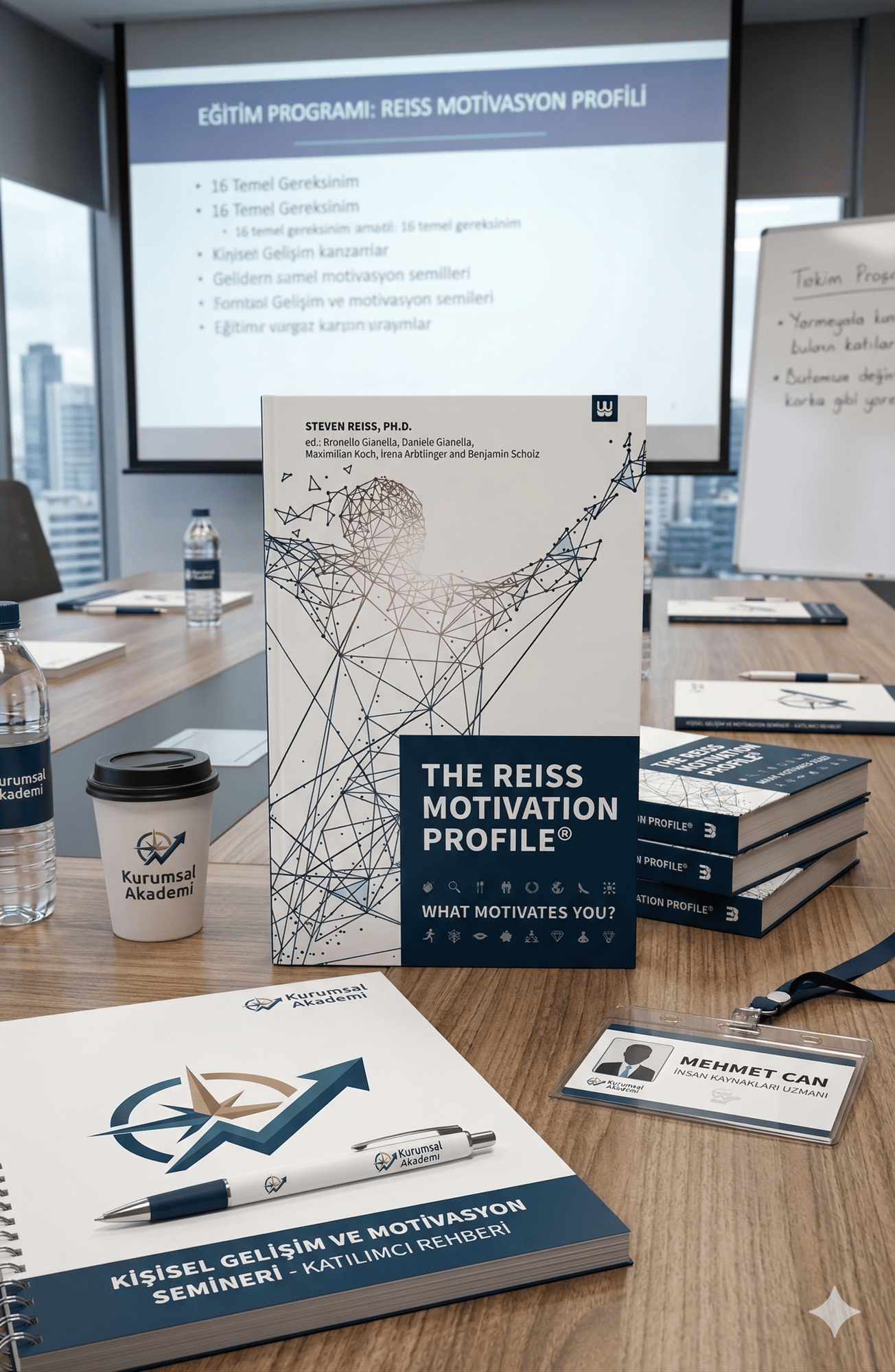
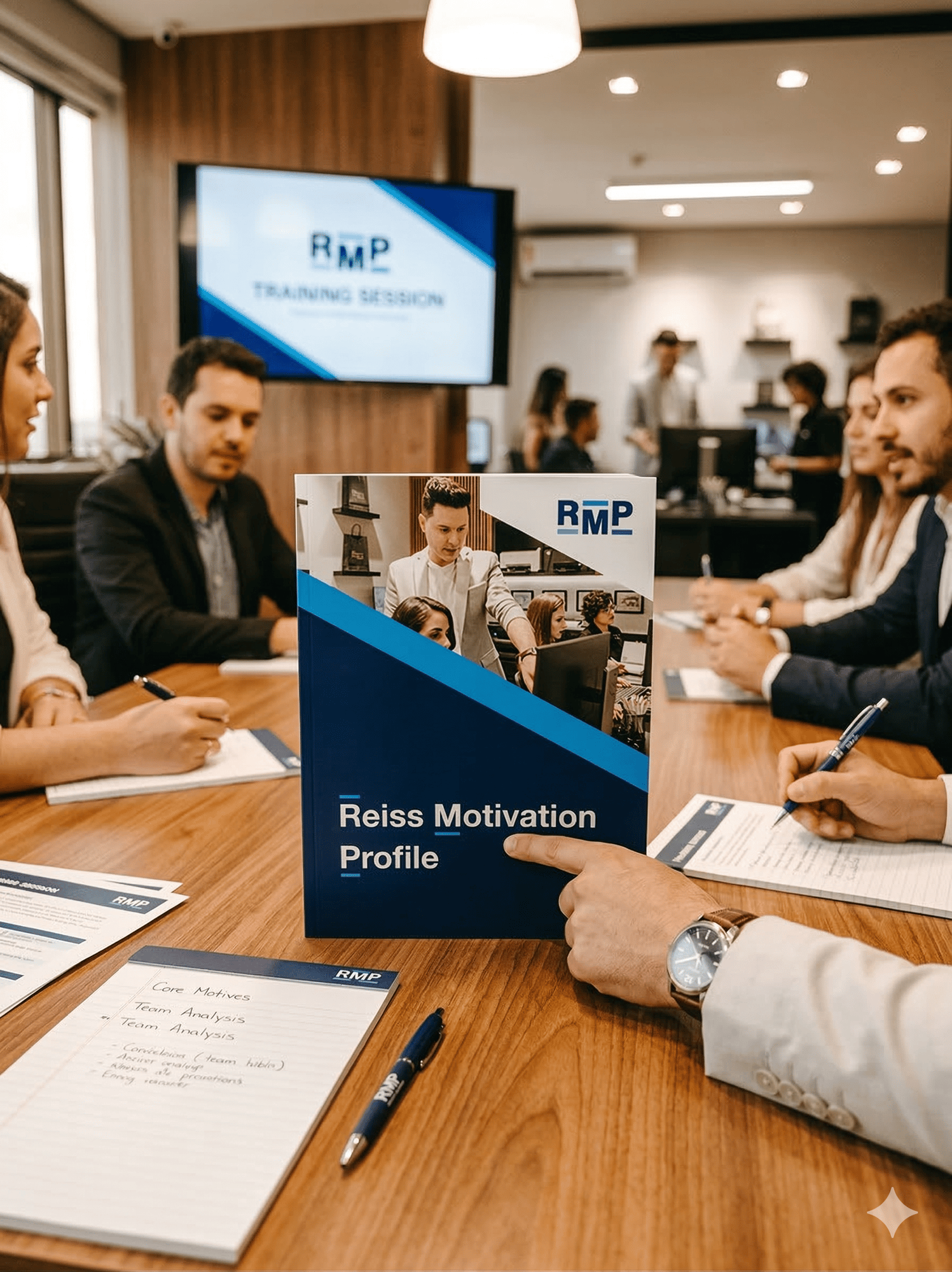
Identifies the motivational roots of individual conflict and can be applied before or after SOCIAL STYLE®

Gemini_Generated_Image_cb3ucscb3ucscb3u Premium Training | MOTG | LOWE | PERC

RMP Motivation Training — Who am I

Motivation style awareness — forms a powerful combination when implemented alongside SOCIAL STYLE®

Gemini_Generated_Image_nbrdx4nbrdx4nbrd Premium Training | PERC | LOWE | GEND

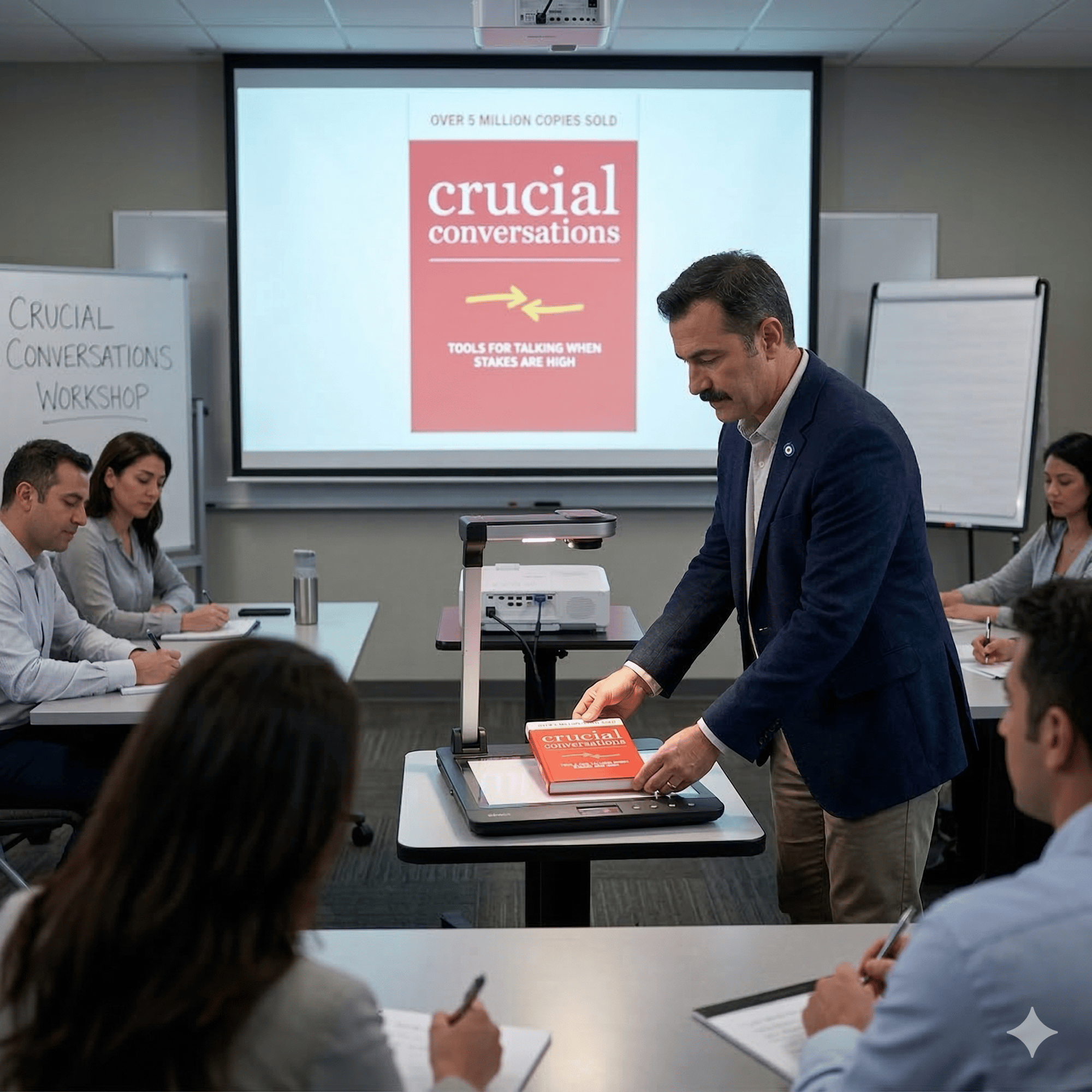
Crucial Conversations® for Mastering Dialogue

Develops the capability to manage difficult and high-stakes conversations after gaining style awareness

Program Details

tag-2

TRACOM Group (TRC)

Partner
tag-2

SOCIAL STYLE® Training

Product Name
tag-2

LEC-PTP-SST-TRC-LDE-LND-DEV-DEL-096

SKU
tag-2

Critical

Challenge Tier
tag-2

LEC

Primary Challenge
tag-2

LEC | MOTG | GEND | LERG | EXG | PERC

Challenge Codes
tag-2

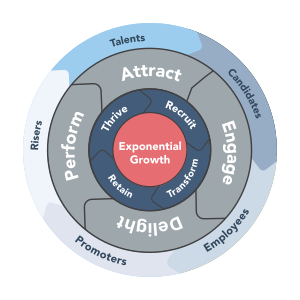
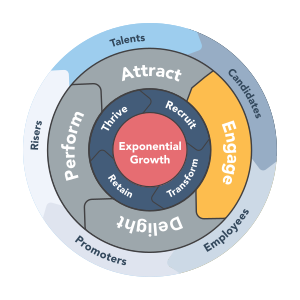
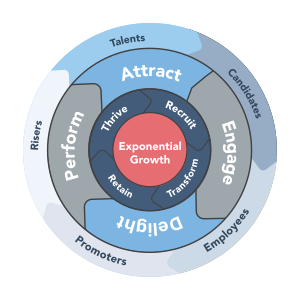
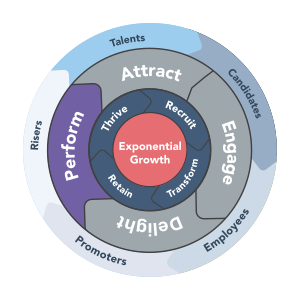
DEL

Flywheel
tag-2

LND — Learning & Development

Persona
tag-2

All Employees, Managers, Sales Teams, CX & Service

Target Audience
tag-2

Min 8 — Max 16

Participants
tag-2

Half Day

Duration
tag-2

In-Person | Live Online | E-Learning

Delivery Format
tag-2

TR / EN

Language Options
tag-2

Pre-Assessment

Optional
tag-2

Customization

Optional
tag-2

SOCIAL STYLE® v3 Assessment (42 items, 360° multi-rater)

Assessment Tool
tag-2

Pre-Work

Optional
tag-2

Training Kit

Available
tag-2

Gamification

Available
tag-2

Certificate

Not Available
tag-2

Awards

Not Available
tag-2

Kraiger & Kirkpatrick (2010) — Colorado State University | TRACOM Technical Report v4.1 (2024)

Additional Resources
tag-2

Post-Training Reinforcement

Optional
tag-2

SOCIAL STYLE® Modules: Improving Personal Effectiveness with Versatility™, Improving Managerial Effectiveness with Versatility™, Improving Sales Effectiveness with Versatility™, Managing for Results™, Selling for Results™ · Other Programs: Adaptive Mindset® for Resilience · Crucial Conversations® · DiSC® Workplace

Follow-Up Programs