






Fortune 100 companies with a CRO or a similar revenue leadership role grow 1.8 times faster than their competitors.

DO YOU
KNOW?
1.8x
 McKinsey
15%
Revenue Operations is one of the fastest-growing job titles in the United States, with an annual global growth rate of 15%.
Source: LinkedIn
$337K
The average base salary for a Chief Revenue Officer (CRO) is $337,000, making it one of the fastest-growing positions within the C-suite.
Source: 2026 C-Suite Data
Common Problems in Many Organizations
Most companies in Türkiye fall into one of these two categories:


No CRO Structure
Sales, marketing, and customer success are led by separate managers. Each team focuses on its own KPIs, with little alignment across functions. Coordination relies on meetings—but once the meeting ends, the silos remain.No CRO Structure
Sales, marketing, and customer success are led by separate managers. Each team focuses on its own KPIs, with little alignment across functions. Coordination relies on meetings—but once the meeting ends, the silos remain.
No CRO Structure
The CEO is responsible for both driving growth strategy and resolving conflicts between departments, leaving little time to focus on strategic leadership.No CRO Structure
The CEO is responsible for both driving growth strategy and resolving conflicts between departments, leaving little time to focus on strategic leadership.


No CRO Structure
In many cases, the CRO role has simply evolved from the Sales Director position. Marketing and customer success continue to operate independently, looking to the CEO rather than the CRO for direction.No CRO Structure
In many cases, the CRO role has simply evolved from the Sales Director position. Marketing and customer success continue to operate independently, looking to the CEO rather than the CRO for direction.

A CRO Structure Exists, but It Is Not Yet Fully Mature
In many cases, the CRO role has simply evolved from the Sales Director position. Marketing and customer success continue to operate independently, looking to the CEO rather than the CRO for direction.A CRO Structure Exists, but It Is Not Yet Fully Mature
In many cases, the CRO role has simply evolved from the Sales Director position. Marketing and customer success continue to operate independently, looking to the CEO rather than the CRO for direction.
No CRO Structure
Sales, marketing, and customer success are led by separate managers. Each team focuses on its own KPIs, with little alignment across functions. Coordination relies on meetings—but once the meeting ends, the silos remain.
No CRO Structure
The CEO is responsible for both driving growth strategy and resolving conflicts between departments, leaving little time to focus on strategic leadership.
No CRO Structure
In many cases, the CRO role has simply evolved from the Sales Director position. Marketing and customer success continue to operate independently, looking to the CEO rather than the CRO for direction.
A CRO Structure Exists, but It Is Not Yet Fully Mature
In many cases, the CRO role has simply evolved from the Sales Director position. Marketing and customer success continue to operate independently, looking to the CEO rather than the CRO for direction.
Hidden Costs of These Problems

Performance Cost
In a poorly designed revenue organization, teams operate in silos. Marketing focuses on activity instead of revenue impact, sales fails to convert leads, and Customer Success struggles to maintain strong customer relationships. Sustainable growth comes from a continuous cycle where happy customers drive referrals and new demand. When teams lack alignment, that cycle slows down and growth becomes harder to maintain.

Cultural Cost
When marketing, sales, and customer success lack alignment, the customer experience becomes inconsistent. Leads lose momentum between teams, customer trust weakens during delivery, and the brand promise becomes unclear.1. A Customer Experience Culture Cannot Be EstablishedA strong customer experience requires all teams to follow the same strategy. Without alignment, customers experience a different version of the company at each touchpoint.2. A Culture of Accountability Cannot DevelopTeams operate in silos and focus only on their own priorities. When revenue goals are missed, instead of shared ownership, departments often shift responsibility to one another.

Strategic Cost
When the revenue organization is not integrated, decisions become driven by department goals rather than customer and business needs. Sales focuses on quotas, marketing on campaigns, and Customer Success on retention, creating fragmented strategies. Instead of driving growth, the organization spends time managing disconnected functions while competitors move ahead with aligned revenue systems.
If These Problems Persist…

After 10 Days
On the surface, everything appears to be operating normally. Marketing is launching campaigns, sales is attending meetings, and Customer Success is closing support tickets. Everyone is busy. Everyone is active. However, activity is not the same as progress. Are the marketing campaigns generating revenue? Are sales meetings turning into qualified opportunities? Are resolved support tickets improving customer retention?
These questions often go unasked because every team reports what they did, not the outcomes they achieved. Since the underlying problem remains invisible, no corrective action is taken.
After 10 Months
Over time, the gap between activity and results becomes impossible to ignore. Revenue targets are missed, and teams begin blaming each other—marketing questions sales follow-up, sales questions lead quality, and Customer Success struggles with customer expectations.
Each team has valid concerns, but there is no unified view of the business. Forecasts become unreliable, leadership confidence declines, and top performers feel the pressure of managing internal conflicts. Meanwhile, competitors with aligned teams, clear GTM strategies, and strong RevOps foundations continue to scale faster.

After 10 Years
At this stage, the problem becomes cultural. “This is simply how we work” becomes the accepted mindset, where activity is mistaken for success and questioning results is seen as criticism. Targets are missed or achieved through unsustainable effort, while processes, values, and customer commitments begin to break down.
Pressure replaces leadership, morale declines, and turnover increases as employees look for better opportunities. Internal politics and self-protection take priority over growth. Over time, competitors move ahead while leadership sees the decline as sudden, even though it developed gradually. Investor confidence weakens, and the organization shifts from strategic growth to constant crisis management.


Achieving sustainable and predictable revenue growth is a critical challenge for leaders who want to take their organizations to the next level.
Chicago Booth Executive Education
What CapabilIity Required to Solve This?
Growth is no longer the responsibility of a single function.
A leader who understands sales strategy but cannot build an organization remains a Sales Director. A marketing leader who cannot connect campaigns to revenue manages a cost center, and a Customer Success leader who cannot improve retention, expansion, and NRR risks long-term success.

Revenue Leadership
Leading the Revenue System
A Chief Revenue Officer (CRO) is responsible for designing, aligning, and scaling sales, marketing, and Customer Success into one integrated revenue system. Without that system, growth becomes dependent on chance rather than strategy.
What Is This Program?
The Chief Revenue Officer (CRO) Programme is Türkiye’s first and only integrated revenue leadership program.
Most CRO programs are university-led executive education courses designed for existing VPs or CROs. They provide strong concepts but leave implementation to participants.
The SP1 Chief Revenue Officer (CRO) Programme takes a practical approach, giving first-time CROs a structured system for success and helping experienced CROs refine their approach through the Revenue Leadership System™.
Participants leave with a practical Revenue Leadership Playbook, a 90-Day CRO Action Plan, and a Revenue Operating System ready for implementation.
The Revenue Leadership System™ is SP1's proprietary methodology that sets its Chief Revenue Officer (CRO) Programme apart from other programs. It is built on three core pillars:

Diagnose
Analyze the organization's existing revenue engine—including marketing, sales, and customer success functions—using a data-driven approach to identify performance gaps and opportunities.
Design
Develop an integrated go-to-market (GTM) strategy, Revenue Operations (RevOps) infrastructure, and cross-functional alignment to create a practical, organization-specific Revenue Blueprint.
Implement
Put the learning into practice through simulations, case studies, and real-world business scenarios, enabling participants to graduate with a fully developed CRO Operating Plan ready for implementation.

Available in Two Formats
 Open Enrollment
 Revenue Organization Transformation
Who It's For
CROs, CCOs, CSOs, VPs of Sales, VPs of Marketing, founders, and business leaders from different organizations
A single company's entire revenue organization—including the CRO, CMO, CSO, Chief Customer Service Officer, along with their directors and teams
Format
Cohort-based learning with peer collaboration among leaders from diverse industries
A company-specific engagement built around the organization's own data, business challenges, and teams
Key Advantage
Learn alongside senior leaders from different industries, gaining valuable peer insights and cross-industry perspectives
Transform the entire revenue organization through a shared language, common methodology, and the Revenue Leadership System™
Outcome
A personalized Revenue Leadership Playbook and a 90-Day CRO Action Plan
A company-specific Revenue Operating System, including a unified go-to-market (GTM) framework and an enterprise-wide transformation roadmap
Program Structure — 12 Modules
Module
Scope
M1
Revenue Engine Assessment
Evaluate the current go-to-market (GTM) strategy, people, processes, and technology. Measure organizational performance using the Revenue Health Score.
M2
Growth Model Design & Building the Revenue Team
Design the GTM strategy, define the Ideal Customer Profile (ICP), segmentation, organizational structure, hiring, onboarding, and sales enablement.
M3
Leading the Revenue Organization
Develop cross-functional leadership, team motivation, performance management, accountability, and coaching for Sales, Marketing, and Customer Success leaders.
M4
Leading the Marketing Organization
Optimize Marketing-to-Sales service-level agreements (SLAs) and improve campaign effectiveness and performance.
M5
Leading the Sales Organization
Develop sales strategy, playbooks, pipeline management, sales coaching, and the effective use of sales technology.
M6
Leading Customer Success, Retention & Expansion
Focus on Customer Lifetime Value (CLV), Net Revenue Retention (NRR), churn management, onboarding, renewals, expansion strategies, and Customer Success–Sales alignment.
M7
Revenue Operations (RevOps): Technology & AI
Select and integrate CRM platforms, technology stacks, AI tools, automation, GTM technologies, and revenue technology architecture.
M8
Revenue Operations (RevOps): Analytics & Reporting
Build executive dashboards, improve forecasting, analyze pipeline performance, and enable data-driven decision-making.
M9
Pricing & Revenue Model Design
Develop pricing strategies, value-based pricing, bundling models, and SaaS revenue metrics.
M10
Revenue Strategy Leadership
Create long-term growth strategies, market expansion plans, new revenue streams, and competitive positioning.
M11
The CRO in the Boardroom
Strengthen board and investor communication, revenue presentations, CEO alignment, and executive presence.
M12
Revenue Leadership Simulation & 90-Day CRO Action Plan
Participate in CEO and board briefings, develop a 12-month strategic plan, defend revenue forecasts, redesign the organization, and deliver a final CRO Operating Plan.
Participants leave the program with more than a certificate. They graduate with a practical, implementation-ready Revenue Leadership Playbook, a comprehensive 90-Day CRO Action Plan, and a Revenue Operating System they can immediately apply within their organizations.
SP1 CRO Program
Revenue Leadership System™
Learning Outcomes

Revenue Engine Assessment
Gain the capability to analyze the organization's current go-to-market (GTM) strategy across people, processes, and technology, while using data to identify growth barriers and improvement opportunities.
Go-to-Market (GTM) Strategy
Learn how to develop and execute a company-specific GTM strategy by combining Ideal Customer Profile (ICP) definition, market segmentation, growth models, and competitive analysis.
New Revenue Streams
Build the ability to identify sustainable revenue opportunities by expanding existing customer relationships, entering new markets, and aligning products with the right customer segments.
Pricing Strategy
Apply value-based pricing, bundling strategies, and dynamic pricing models to optimize revenue generation within your organization.
Cross-Functional Alignment
Learn how to align Marketing, Sales, and Customer Success around a shared language, common KPIs, and a unified operating rhythm, enabling them to function as a single, integrated revenue system.
Marketing Leadership
Develop expertise in demand generation, pipeline creation, and aligning brand strategy with revenue objectives, while learning how to measure marketing's contribution to business growth.
Sales Leadership
Master a predictable revenue generation methodology by combining sales playbooks, pipeline management, coaching, and sales technology.
Customer Success Leadership
Learn how to drive customer retention, expansion, and revenue growth from existing accounts by offsetting revenue lost through customer churn with upsell and expansion opportunities.
Leadership Coaching for Functional Directors
Build the capability to coach Sales, Marketing, and Customer Success Directors according to their specific roles while aligning all three functions through a common Revenue Leadership framework.
Revenue Talent Lifecycle
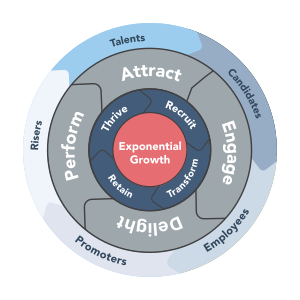
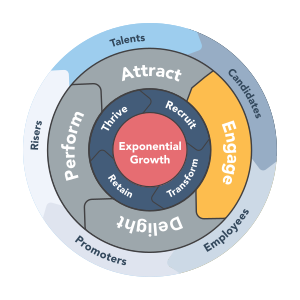
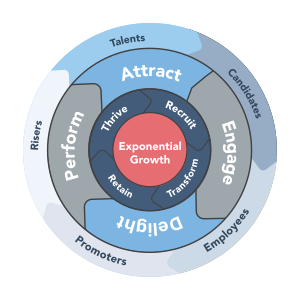
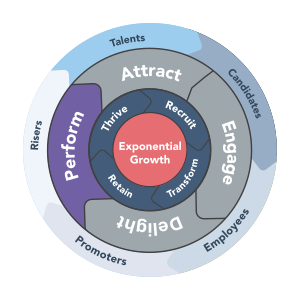
Learn how to build and manage a high-performing revenue organization through the complete talent lifecycle: Attract → Recruit → Transform → Retain → Perform → Delight, including hiring, onboarding, enablement, motivation, and retention.
Compensation Plan Management
Develop the expertise to design and manage compensation, incentive, and commission plans for Sales, Marketing, and Customer Success teams that are aligned with the organization's growth objectives.
RevOps Infrastructure
Master the methodology for selecting, designing, and managing CRM platforms, technology stacks, automation tools, and system integrations that support scalable revenue growth.
Data-Driven Decision Making
Develop the ability to make informed decisions through forecasting, pipeline analysis, and RevOps dashboards. Learn how to leverage descriptive, predictive, and prescriptive analytics to improve business performance.
AI Integration
Learn how to transform artificial intelligence into a strategic advantage across go-to-market (GTM) processes and prepare the organization to effectively adopt and scale AI-driven capabilities.
Board-Level Communication
Develop the ability to present revenue strategy, defend forecasts with confidence, and communicate a compelling growth narrative to the CEO and Board of Directors.
Revenue Leadership Playbook
Complete the program with a Revenue Leadership Playbook, 90-Day CRO Action Plan, GTM framework, organizational redesign recommendations, and CRO Operating Plan built with proven methodologies.
Who Is This For?
 This program is suitable for
Vice Presidents who want to transition from Sales, Marketing, or Customer Success leadership into a Chief Revenue Officer (CRO) role.
Founders and business owners who currently serve as—or aspire to operate like—a CRO and want to strengthen their leadership effectiveness.
Current CROs seeking to manage all revenue-generating functions through a fully integrated revenue operating model.
CROs leading global organizations with sales, marketing, and customer service teams across multiple countries who want to improve alignment and leadership at scale.
Chief Commercial Officers (CCOs) and Chief Sales Officers (CSOs) looking to redesign and optimize their revenue strategy.
CEOs and business owners who want to build a data-driven, systems-based go-to-market (GTM) strategy.
Revenue leaders at scale-ups and enterprise organizations looking to accelerate sustainable business growth.
Data-driven leaders who manage sales, marketing, and customer service based on insights and analytics rather than intuition, using data to guide the direction of the entire revenue organization.
 Not Suitable For
Leaders who are focused solely on optimizing a single function and view revenue growth primarily through the lens of sales.
Executives who resist data and analytics, preferring to rely on intuition rather than evidence-based decision-making.
Leaders who prioritize only their own function and do not see cross-functional leadership as essential to business growth.
Professionals who lack the time or commitment for continuous learning, and are looking for quick fixes rather than long-term capability development.
Leaders who have advanced based on tenure or title, but are unwilling to challenge their current approach or invest in further growth.
Executives who believe their past experience and achievements are sufficient, and are not open to new perspectives or external feedback.
Leaders without hands-on experience in sales, marketing, or customer service who attempt to manage revenue organizations from a purely theoretical perspective.
Executives who view the revenue organization as synonymous with the sales function, treating marketing and customer success as secondary rather than integral drivers of sustainable revenue growth.
 Urgent
Why Now?
Most Chief Revenue Officer (CRO) programs on the market are delivered in an executive education format.
They typically require participants to already hold a Vice President or CRO position and have 8–10+ years of leadership experience. While these programs offer strong theoretical foundations, the responsibility for applying the concepts in practice is largely left to the participant.
Typical CRO Programmes
SP1 CRO Program
Format
Executive Education
Modular, Practice-Based Program
Content
Theoretical / Academic
Practical / Simulation-Based
Outcome
Certificate
Revenue Operating Plan + Playbook
Methodology
None
Revenue Leadership System™
Target Audience
Existing CROs
VP-to-CRO Transition Leaders + Existing CROs
Assessment
None
Revenue Health Score Assessment
Key Outcomes

Revenue Health Score
Measure the health of your organization's revenue engine with a comprehensive assessment across Marketing, Sales, and Customer Success.

CRO Programme
Redesign, build, and scale your revenue engine through 12 modules powered by the Revenue Leadership System™.

Revenue Leadership System™
Implement a lasting Revenue Operating System across your organization.
"Fortune 100 companies with a CRO or a similar revenue leadership role grow 1.8 times faster than their competitors. Today, the role is no longer a nice-to-have—it's a competitive necessity."
McKinsey
Related Solutions
.jpg?width=668&height=1024&name=unnamed%20(17).jpg)
 STRG
STRG
Leading Strategy and Innovation
Strategy and innovation leadership support aligned with Module 10: Revenue Strategy Leadership.
GROC
Revenue Leadership Coaching
One-on-one strategic coaching for Chief Revenue Officers (CROs).
AIA
AI-Driven Strategy Leadership Coaching
Executive coaching to integrate AI into your revenue strategy and go-to-market operations.
Program Overview

Chief Revenue Officer (CRO) Program
Programme Name
TBD
SKU
SP (SP1 In-House) + Industry Experts
Partner
GROC
Challenge Code
PERFORM
Flywheel
Revenue Leadership System™
Methodology
CROs, VPs of Sales, VPs of Marketing, CCOs, CSOs, and Business Owners
Who Should Attend
TBD — 12 Modules
Duration
TBD — Hybrid
Delivery Format
TR / EN
Language
Included — Revenue Health Score (RHS)
Pre- Assessment
Optional
Customization
TBD
Assessment & Certification
Revenue Leadership Coaching · AI-Driven Strategy Leadership
Next Programmes