






 Chat
Chat

Building Human Capital Strategy
"The Strategy Is Ready — But Is Your Organization?"
Strategy meetings go well, documents are ready, presentations are impressive — yet nothing changes on the ground. Because the most critical layer behind the strategy is missing: a human capital architecture that identifies the right talent, places them in the right roles, and develops them over the long term. This consultancy ensures your strategy is backed by a truly operational human infrastructure.
 Persona
 Project Duration
 Min. Engagement
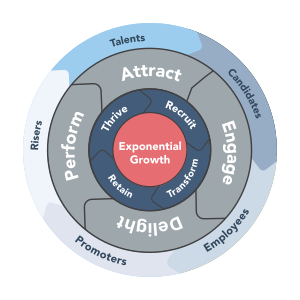
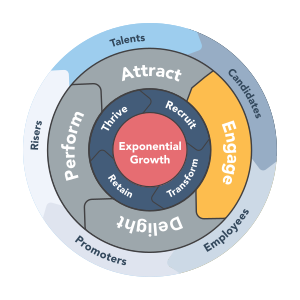
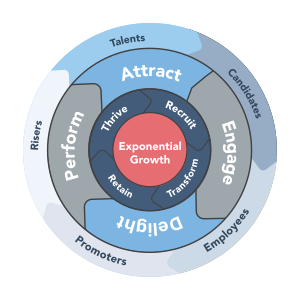
 Flywheel
 Partner
What Is It?
Most organizations build good strategy — but fail to build the human infrastructure to match. Building Human Capital Strategy, a consultancy program that places the right people in the right roles and develops them for the long term. We map who can do what, identify the gaps, and co-design the path to close them. The outcome is not a report — it is a living system that informs every decision, from hiring to promotion, from succession planning to development pathways.
We answer three questions: Who has what, right now? Who do we need to execute our strategy? How do we close the gap between the two? RMP motivation profiles and leadership assessments are the backbone of these questions — because competency alone is not enough; without motivation, even your best people leave.

Our Core Belief
Most organizations think they manage talent well — when in reality, they are only filling positions. A human capital strategy defines not where people are, but where they can go — and what it takes to get them there. Failing to answer this question in an era where AI is transforming everything is the greatest strategic blind spot.

SWOT — Typical Organizations Profile
This is the typical SWOT profile of organizations without a human capital strategy.
Strengths
 In-house talent exists but has not been mapped
In-house talent exists but has not been mapped
In-house talent exists but has not been mapped
In-house talent exists but has not been mapped
In-house talent exists but has not been mapped
In-house talent exists but has not been mapped
In-house talent exists but has not been mapped
Weaknesses
 No succession plan for critical roles
Competency framework is not linked to business strategy
Hiring decisions still rely on intuition rather than data
High-potential employees are leaving
No succession plan for critical roles
Competency framework is not linked to business strategy
Hiring decisions still rely on intuition rather than data
High-potential employees are leaving
Opportunities
 AI tools have made human capital management scalable
AI adoption requires new role definitions
AI has reshuffled the deck — every company is back to zero
Competitors are fighting the same talent bottlenecks
AI tools have made human capital management scalable
AI adoption requires new role definitions
AI has reshuffled the deck — every company is back to zero
Competitors are fighting the same talent bottlenecks
Threats
 Loss of critical talent can bring strategic projects and future plans to a halt
The rules of talent management are being rewritten — AI is reshaping roles and raising the bar for human contribution
Reactive hiring costs 3–5x more than proactive planning
In uncertain economic climates, people investment is often the first budget line to be cut
Loss of critical talent can bring strategic projects and future plans to a halt
The rules of talent management are being rewritten — AI is reshaping roles and raising the bar for human contribution
Reactive hiring costs 3–5x more than proactive planning
In uncertain economic climates, people investment is often the first budget line to be cut
Who It’s For / Who It’s Not For
 Companies with a strategic growth plan but no clearly defined human infrastructure to support it
Organizations experiencing high turnover in critical roles
CHROs looking to move talent management from intuition to system
Leaders who want to map their human capital before the AI transformation wave
Mid-to-large companies beginning to take succession planning seriously
Companies with a strategic growth plan but no clearly defined human infrastructure to support it
Organizations experiencing high turnover in critical roles
CHROs looking to move talent management from intuition to system
Leaders who want to map their human capital before the AI transformation wave
Mid-to-large companies beginning to take succession planning seriously
 Managers expecting quick wins and looking for a 2–3 month fix
Companies that consider digitizing HR processes sufficient
Projects without senior leadership and CEO sponsor support
Organizations with fewer than 50 people
Companies forced to defer people investment due to budget pressure
Leadership teams that continue to view human capital as a cost line
Managers expecting quick wins and looking for a 2–3 month fix
Companies that consider digitizing HR processes sufficient
Projects without senior leadership and CEO sponsor support
Organizations with fewer than 50 people
Companies forced to defer people investment due to budget pressure
Leadership teams that continue to view human capital as a cost line
What Do You Get?
Talent map and gap analysis
Rol mimarisi ve yetkinlik-motivasyon profilleri
Individual and organizational development roadmap
Entegre human capital sistemi
Succession pipeline
Numbers
Research consistently points to the same conclusion: failing to manage human capital is expensive.

%91

2x

%75+
Value Timeline

Working Model
Mevcut Durumu Anla

Sistemi Tasarla

Activate

Tutundur

Mevcut Durumu Anla

Sistemi Tasarla

Activate

Tutundur
How We Work Together

One Meeting Every Week — No Surprises
Every week, a progress meeting is held with the project sponsor and leadership team. Findings, decisions, and next steps are shared transparently — no surprises.

We Don't Wait for Problems — We Solve Them Immediately
If a critical finding emerges, the next scheduled meeting is not waited for. Real-time sharing and fast decision loops set the tempo of the project.

Technology Recommendations — Only What Actually Works
In areas where tools are needed during the consultancy, we only recommend tools we have personally used and seen results from.

Field Support — Ownership Stays With You
Every week, a progress meeting is held with the project sponsor and leadership team. Findings, decisions, and next steps are shared transparently — no surprises.

We Build Together — We Don't Deliver and Leave
All work is carried out side by side with the client team. Role profiles, gap analyses, and development plans are co-designed; there is no "consultant draws, client approves" model.

Transfer — No Dependency
We don’t do classic consulting — advise and exit. We co-build the knowledge, tools, and approaches that will make your team capable. When the project ends, you shouldn’t need us.
Objection Handling

"We already have an HR department — we can do this ourselves."
 OUR ANSWER
"Su an dogru zaman degil, daha acil onceliklerimiz var."
OUR ANSWER
"16-24 hafta cok uzun, sonuclari bekleyemeyiz."
OUR ANSWER
"Our team doesn’t have the bandwidth for this project right now."
OUR ANSWER
"Can we shorten the project? Let’s skip the diagnosis phase — we already know our problem."
OUR ANSWER

"We already have an HR department — we can do this ourselves."
OUR ANSWER
"Su an dogru zaman degil, daha acil onceliklerimiz var."
OUR ANSWER
"16-24 hafta cok uzun, sonuclari bekleyemeyiz."
OUR ANSWER
"Our team doesn’t have the bandwidth for this project right now."
OUR ANSWER
"Can we shorten the project? Let’s skip the diagnosis phase — we already know our problem."
OUR ANSWER
Our
Approach

Data first, intuition second

Competency alone is not enough

Build a system, not a project
Trusted Technology & Consulting Partners
We collaborate with best-in-class platforms and specialists to deliver real results.

Prerequisites For Success
This project delivers results only when the following conditions are met.

Executive Sponsorship

Goal Alignment

Openness to Feedback

Marathon Mindset
Related Solutions
 Program
Power of Habit®
Turn behavioral change into lasting habit
Program
Power of Habit®
Turn behavioral change into lasting habit
Program
Power of Habit®
Turn behavioral change into lasting habit
Program
Power of Habit®
Turn behavioral change into lasting habit
Related Resources
Everything you need to explore, implement, and master the GTD methodology


Program Details

Overview
 Persona
 Project Duration
 Min. Consulting Days
 Dil
Dil
What’s Included
-
 In-Person
 -
Live Online
-
Hybrid
-
Pre-AnalysisStrategic Planning Documents
-
AssessmentRMP + Leadership Assessment
-
Project Management Platform
-
Executive/Sponsor Interview
-
Reporting
-
Supporting Resources
-
Workshop
-
 E-LearningOptional
 -
Micro LearningOptional
-
Implementation SupportOptional
 Recommended Training
Crucial Conversations for Mastering Dialogue RMP Motivation Training — Who am I