







 WhatsApp
 Assessment
Motivation Insight (RMP):
RMP for Individual Coaching
-
Have the individuals you sponsored for coaching felt disappointed after the program?
-
Are you able to observe sustained behavioral change after coaching?
-
How many individuals who receive coaching maintain lasting behavioral change after one year?
-
Have your HR and Talent teams experienced frustration because coaching investments fail to produce long-term results?

15%
While 95% of leaders believe they know themselves, in reality only 15% are truly self-aware. (FMI Corp Research)
60%
60% of individuals who receive coaching revert to their previous behaviors within 3 months. (PMC Research)
50%
Half of executive coaching programs fail to deliver the expected outcomes. (Korn Ferry)
-
 15-20 Mins
-
 128 Questions
-
 1 (individual)
-
 Motivation Insight (RMP)
 Coaching Without Motivation Analysis
Standard frameworks are applied, making meaningful alignment difficult
The individual’s true motivations cannot be identified
Goals are defined based on the coachee’s own declarations
Behavioral change often fades within 3 months
 Coaching With Motivation Analysis
A personalized motivation map is created, enabling accurate alignment
16 core motivations are scientifically measured to identify the individual’s true drivers
Goals are aligned with genuine motivational drivers
Motivation-based strategies enable sustainable behavioral change
What is RMP for Individual Coaching?
RMP for Individual Coaching reveals the key to sustainable success in coaching processes. While around 50% of traditional coaching approaches fail, motivation-based coaching enables lasting behavioral change.
This assessment analyzes 16 core motivations, helping uncover the individual’s true internal drivers and enabling the design of personalized coaching strategies.

RMP for Individual Coaching — Product Overview

RMP for Individual Coaching
Product Name
Motivation Insight (ASS)
Survey Category
RMP (Reiss)
Partner
MOTG (Primary) | PERC | LERG | TALS | LEC | EXG
Challenge
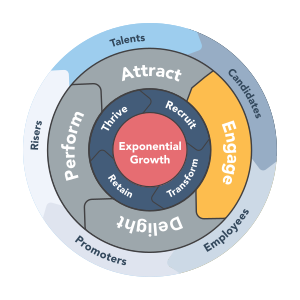
ENGAGE
Flywheel
All Leaders
Target Audience
128 Questions
Number of Questions
15-20 minutes
Completion Time
1 (Individual)
Minimum Participants
RMP 16 Motivation
Methodology
Online Platform
Delivery Method
Turkish / English
Language Options
Individual Motivation Profile + Coaching Guide
Reporting
RMP Global Norm Group
Benchmark
Customized analysis based on the coaching focus
Customization
Assessment + 12 Coaching Sessions
Package Scope
Project Manager
Not Included
Microlearning and Reinforcement
Optional Services
Related Success Programme Solutions
 Related Assessments
RMP for Leadership Development
RMP for Career Coaching
RMP for Performance Coaching
RMP for High Potential Development
RMP for Executive Coaching
Leadership Competency Assessment
Show More
Related Training & Consulting
RMP Certification Training (PTP)
Coaching Skills Workshop (PTP)
Crucial Conversations® (PTP)
Everything DiSC® Management (PTP)
Leadership Development Program (CON)
Executive Coaching (COA)
Show More
Sales & Marketing Statistics
Half of Coaching Programs Fail
~50% failure rate — Korn Ferry (2014), Deloitte: Some estimates suggest that half of coaching initiatives fail.
3%–97% variability — Chief Learning Officer: Coaching outcomes are highly inconsistent.
Daha Fazla Göster
Behavioral Change Is Not Sustained
60% relapse within 3 months — PMC Research (Hunt et al., 1971)
70–80% relapse within one year, with only 20–30% sustained success — Transtheoretical Model
5–30 serious attempts required for lasting behavioral change — Kelly et al., 2019
43% relapse even after 12 months — 1990 Surgeon General’s Report
Daha Fazla Göster
Learning Retention Is Low
50% forgotten within 5 weeks — Training Industry
84% forgotten within 90 days — Training Industry
Daha Fazla Göster
Goal Setting Failures
92% fail to achieve their goals — University of Scranton
55% self-report bias — Stronger By Science
Goal failure leads to decreased motivation — Frontiers in Psychology (2021)
Daha Fazla Göster
Lack of Self-Awareness
95% vs. 10–15% gap in self-awareness — FMI Corp: While 95% of leaders believe they are self-aware, only 10–15% actually are.
60% of coaching outcomes remain confidential — Stanford Survey: Learnings are not translated into practice.
Daha Fazla Göster
Coach–Coachee Misalignment
45% disappointment rate — Schermuly (2014): 45% of coaches report not seeing long-term results.
Motivation is often misunderstood — British Psychological Society: A critical factor is frequently overlooked.
Daha Fazla Göster
Standardized Approach Problem
Overreliance on standardized frameworks — Medium (Andrew Rosenstock): People are not statistics.
Inconsistent evidence — PMC Systematic Review: Popular coaching techniques often rely on low-quality evidence.
Daha Fazla Göster