







 WhatsApp
While the probability of making a sale to an existing customer is 60–70%, the probability of making a sale to a new customer is only 5–20%.

DID YOU
KNOW?
5–20%
 Marketing Metrics
Common Problems in Many Organizations


In many organizations, customer service is still viewed as a cost center—rather than a function that generates revenue and fosters customer loyalty.
In many organizations, customer service is still viewed as a cost center—rather than a function that generates revenue and fosters customer loyalty.


In many organizations, success is measured using the wrong KPIs: number of tickets, response time, SLA... but they don’t measure how many customers were retained or how many were won back.
In many organizations, success is measured using the wrong KPIs: number of tickets, response time, SLA... but they don’t measure how many customers were retained or how many were won back.



In many organizations, the customer experience varies from person to person: there is a huge gap between the best representative and the average one, and there is no consistent standard.
In many organizations, the customer experience varies from person to person: there is a huge gap between the best representative and the average one, and there is no consistent standard.


In many organizations, service staff are trained to solve problems, not to build trust.
In many organizations, service staff are trained to solve problems, not to build trust.
In many organizations, customer service is still viewed as a cost center—rather than a function that generates revenue and fosters customer loyalty.
In many organizations, success is measured using the wrong KPIs: number of tickets, response time, SLA... but they don’t measure how many customers were retained or how many were won back.
In many organizations, the customer experience varies from person to person: there is a huge gap between the best representative and the average one, and there is no consistent standard.
In many organizations, service staff are trained to solve problems, not to build trust.
The Hidden Costs of Problems

Operating Costs
Service staff can identify a customer’s problem; however, when they lack the authority to resolve it, the organization cannot make use of its most valuable resource: the judgment of the person closest to the customer.

Cultural Cost
Over time, taking the initiative becomes a behavior that is punished, while following procedures becomes one that is rewarded. Eventually, the team begins to work not for the customer, but to avoid making mistakes—and customer focus gives way to procedure focus.

Strategic Cost
The company overlooks the most profitable growth opportunity right under its nose: its existing customers. It fails to recognize the growth it could generate from the customers it already has; instead, it continues to seek growth by constantly acquiring new customers.
If the Erosion of Trust Continues
10 DAYS
No one notices anything. All the metrics are in the green, tickets are closed, and SLAs are met. But the customer no longer trusts you as much as they used to. (Invisible)
10 MONTHS
The signs begin to appear. High-performing employees start to burn out, customers quietly walk away, and the team begins to focus on managing procedures rather than building trust. (You can feel it)
10 YEARS
Erosion becomes ingrained in the organization’s DNA. Because the company cannot foster loyalty, it is constantly forced to acquire new customers and compete on price. It is no longer a matter of individuals who cannot build trust, but rather an organization that cannot build trust. (Structural)


“Companies lose their customers not because of a single major mistake, but because of hundreds of small breaches of trust that occur every day.”
What Capability Is Required To Solve These Challenges?
Organizations cannot solve these problems simply by improving their processes. Service employees must have the ability to build trust in every customer interaction.
None of these problems can be solved with a single training program. However, no organization can permanently resolve these issues without developing its service employee'sability to build trust.

Customer Trust
Building
The ability to build trust results from a combination of behaviors that enable one to understand the customer, exercise sound judgment, communicate effectively, take initiative, and rebuild trust.
What is Aslan Experience?
The ASLAN Experience is designed to help organizations halt the erosion of customer trust by developing service employees’ ability to build trust. It teaches them not just to resolve issues more quickly, but to turn every customer interaction into an opportunity to build trust.
The program is built on ASLAN’s Other-Centered® approach: a proprietary philosophy that shifts the representative’s focus from “resolving the issue” to “truly understanding the customer.” This approach is structured into three modules—Role, Relationship, and Partner —forming a repeatable framework that enables representatives to maintain and grow trust in every interaction.
ASLAN’s Other-Centered® methodology has been used to develop teams interacting with customers in many countries around the world, drawing on nearly thirty years of field experience. Experience adapts this approach directly for service teams.
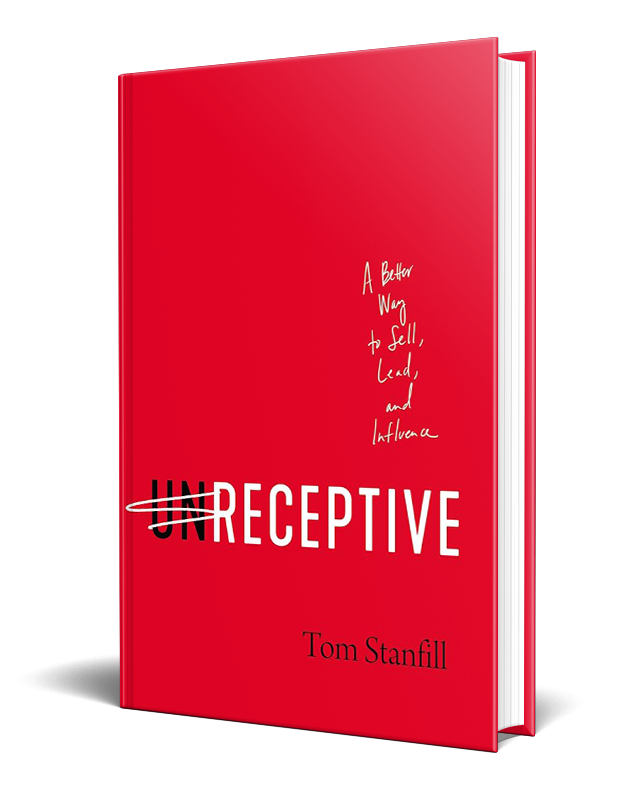
ASLAN develops these behaviors throughout the Role–Relationship–Partner learning journey using the Connect–Discover–Support–Check–Thank approach.
Learning Outcomes

Handle difficult customer conversations with greater confidence.
Take more initiative by effectively using their decision-making authority.
Exercise better judgment and make better decisions under pressure.
Develop a shared language and consistent approach to trust-building and service.
Strengthens the commercial impact of service teams.
Supports customer retention initiatives.
Contributes to delivering a more consistent customer experience.
ASLAN Experience
By enhancing service staff’s ability to build trust, it helps create more consistent customer experiences, strengthens customer retention efforts, and fosters a trust-focused service culture throughout the organization.
Who Is It For?
 A Good Fit
Organizations that view service as a strategic component of customer loyalty and growth
Teams that want to standardize the customer experience and make it less dependent on individual staff members
Leaders who want to give service employees more decision-making authority
Companies that view customer trust as a competitive advantage
Organizations that view developing the competence of their current service team as an investment in growth
 Not a Good Fit
Organizations that view customer service solely as call and ticket management
Organizations that try to ensure a consistent customer experience not through systems, but solely through the individual efforts of their employees
Organizations that try to manage every decision through procedures rather than trusting their staff
Organizations that still believe customer loyalty is determined by product and price
Organizations that try to address every new service need by hiring new employees
 Urgent
Why Now?

Knowledge is no longer an advantage.
Artificial intelligence has democratized access to information. It is no longer information that makes the difference—it is the trust built with the customer.
Every remaining human interaction has become more challenging.
As AI and self-service take over routine tasks, customers only reach out to a human when things get really difficult. Every interaction in which a human steps in becomes a critical moment that tests trust.
Customer patience is running out.
More options, less tolerance. A bad experience is no longer quietly forgotten; it’s shared instantly, and switching to a competitor is just a click away.
As products become more similar to one another
Customer experience is becoming one of the most important determinants of competitive advantage—and service is at the heart of that experience.
SP INSIGHT
AI doesn’t diminish the importance of customer service; it enhances it. Because as AI handles routine problems, every moment when a human steps in becomes a more complex, more emotional, and more trust-intensive moment.
77% of CRM leaders believe that, by 2025, the majority of customer requests will be handled by AI. This means that every interaction involving a human will no longer be routine, but rather a critical moment.
HubSpot
State of Service 2024
Related Solutions
.png?width=1184&height=864&name=Gemini_Generated_Image_dfgvqfdfgvqfdfgv%20(1).png) Assessment
Assessment
CSAT Survey
It measures customer satisfaction in service interactions and establishes a baseline for capacity development.
.jpg?width=1024&height=572&name=unnamed%20(19).jpg) Assessment
Assessment
Customer Retention Survey
It measures customer retention performance and churn signals.
 Training
Customer Service and Sales Skills
It helps service teams turn customer interactions into value and opportunities.
Consulting
Customer Service Design
It redesigns service processes with a focus on the customer experience.
Consulting
Customer Experience Design
Strategically designs the end-to-end customer experience.
Program Overview

CXG-PTP-EXP-ASL-CXD-CRO-DEL-167
SKU
ASLAN Training
Partner
CXG (Customer Experience Issues)
Challenge
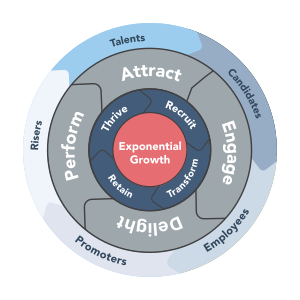
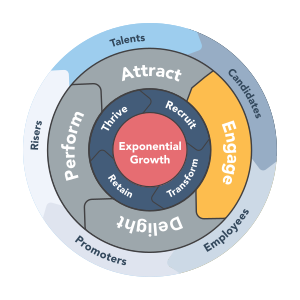
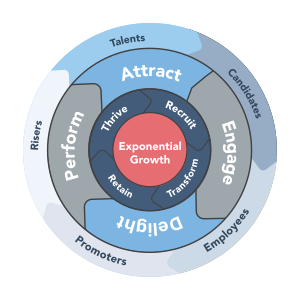
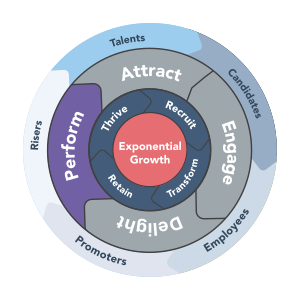
DELIGHT
Flywheel
CX & Service Teams, Customer Experience Representatives, Customer Success Managers, Inside Support Teams
Target Audience
Min 8 - Max 16
Number of Participants
2 Days
Duration
Face-to-Face - Live Online
Delivery Format
TR / EN
Language Option
Optional
Pre-Assessment
Available (by sector / interaction type)
Customization
Available — RMP (Reiss Motivation Profile)
Assessment Tools
Included
Available — CSAT Survey (service structure baseline)
Workbook, User Guide, Cards
Assessment Tools
Included
Gamification
Available
Certificate
Optional
Recognition & Rewards
Video Library, Article
Additional Resources
Optional (Follow-up Coaching / Call Evaluation)
Post-Program Reinforcement
Optional (CSAT / Escalation / Retention)
ROI Measurement
 Recommended Training
Crucial Conversations for Mastering Dialogue RMP Motivation Training — Who am I
 Recommended Training
Crucial Conversations for Mastering Dialogue RMP Motivation Training — Who am I
Recommended Training
Crucial Conversations for Mastering Dialogue RMP Motivation Training — Who am I