







 WhatsApp
Research conducted on more than 500 senior executive candidates shows that emotional competence is a significantly stronger predictor of success than intelligence or work experience. Moreover, 85% of financial success is attributed to EQ, while IQ accounts for only 15%.
The number one predictor of leadership success is not IQ or experience — it is emotional competence.

DO YOU
KNOW?
85%
 Cherniss, C. — The Business Case for Emotional Intelligence, 1999
 Urgent
Leadership development consists of two components
Most organizations invest heavily in the first—and leave the second to chance. .
Competence
Emotional Intelligence
So is the problem intelligence? No.
Your leaders are already intelligent — and that intelligence works well in managing business operations. However, in managing people, the same intelligence often leads them into a cycle of silence or escalation: conflict, competition, pressure, or ignoring disengagement. They get results — but at the cost of either exhausting or losing their people.

Because without emotional intelligence, people management turns into power management. And any team led through power will eventually either decline in performance or leave the organization.
Common Problems in Many Organizations
Technically strong leaders — but always with the same blind spot:


Manages the Work — But Not the Team’s Emotions
High technical competence and strong operational understanding. However, they cannot read what their team is feeling. They fail to notice when the atmosphere in a meeting shifts. They do not see what breaks down in the team after a decision is made. They manage the work — but not the emotional climate.Result: The team becomes silent, and the leader realizes it far too late.Manages the Work — But Not the Team’s Emotions
High technical competence and strong operational understanding. However, they cannot read what their team is feeling. They fail to notice when the atmosphere in a meeting shifts. They do not see what breaks down in the team after a decision is made. They manage the work — but not the emotional climate.Result: The team becomes silent, and the leader realizes it far too late.
Loses Emotional Stability Under Pressure
When faced with difficult situations — delayed work, missed targets, lost opportunities, negative customer feedback, disruptions, or mistakes — they struggle to regulate their emotions. The calm demeanor they normally have disappears, and they react impulsively. This creates trust issues within the team. Result: The team no longer believes in their calm appearance during normal times.Loses Emotional Stability Under Pressure
When faced with difficult situations — delayed work, missed targets, lost opportunities, negative customer feedback, disruptions, or mistakes — they struggle to regulate their emotions. The calm demeanor they normally have disappears, and they react impulsively. This creates trust issues within the team. Result: The team no longer believes in their calm appearance during normal times.


Pretends to Listen — But Does Not Really Listen
They want to be the only one speaking. They expect the team to listen attentively when they speak. While employees are talking, they maintain eye contact and nod, but they're already preparing their response. Employees can tell they are not being heard, which makes them feel undervalued. Over time, they stop bringing real issues, assuming “it won’t be listened to anyway.” Result: Information does not flow upward, and managers make decisions based only on what they see themselves.Pretends to Listen — But Does Not Really Listen
They want to be the only one speaking. They expect the team to listen attentively when they speak. While employees are talking, they maintain eye contact and nod, but they're already preparing their response. Employees can tell they are not being heard, which makes them feel undervalued. Over time, they stop bringing real issues, assuming “it won’t be listened to anyway.” Result: Information does not flow upward, and managers make decisions based only on what they see themselves.

Cannot Build a Genuine Relationship with the Team
Work and targets are discussed, but there is no real human connection with employees. They cannot build rapport because they do not understand what employees feel or want. Their focus remains on their own expectations and what they can extract from employees. The feeling of “I would go the extra mile for this leader” never emerges. Result: Engagement is low, and motivation comes from obligation rather than inspiration.Cannot Build a Genuine Relationship with the Team
Work and targets are discussed, but there is no real human connection with employees. They cannot build rapport because they do not understand what employees feel or want. Their focus remains on their own expectations and what they can extract from employees. The feeling of “I would go the extra mile for this leader” never emerges. Result: Engagement is low, and motivation comes from obligation rather than inspiration.
Manages the Work — But Not the Team’s Emotions
High technical competence and strong operational understanding. However, they cannot read what their team is feeling. They fail to notice when the atmosphere in a meeting shifts. They do not see what breaks down in the team after a decision is made. They manage the work — but not the emotional climate.Result: The team becomes silent, and the leader realizes it far too late.
Loses Emotional Stability Under Pressure
When faced with difficult situations — delayed work, missed targets, lost opportunities, negative customer feedback, disruptions, or mistakes — they struggle to regulate their emotions. The calm demeanor they normally have disappears, and they react impulsively. This creates trust issues within the team. Result: The team no longer believes in their calm appearance during normal times.
Pretends to Listen — But Does Not Really Listen
They want to be the only one speaking. They expect the team to listen attentively when they speak. While employees are talking, they maintain eye contact and nod, but they're already preparing their response. Employees can tell they are not being heard, which makes them feel undervalued. Over time, they stop bringing real issues, assuming “it won’t be listened to anyway.” Result: Information does not flow upward, and managers make decisions based only on what they see themselves.
Cannot Build a Genuine Relationship with the Team
Work and targets are discussed, but there is no real human connection with employees. They cannot build rapport because they do not understand what employees feel or want. Their focus remains on their own expectations and what they can extract from employees. The feeling of “I would go the extra mile for this leader” never emerges. Result: Engagement is low, and motivation comes from obligation rather than inspiration.
Hidden Costs of These Problems

Performance Cost
According to Gallup research, 70% of team engagement is directly driven by a manager’s behavior and emotional tone. Teams led by managers with low EQ tend to become quiet in meetings, withhold ideas, and shift into a “just get the work done” mindset. Performance may not appear to decline — but work is consistently delivered well below potential. Gallup, State of the Global Workplace, 2025

Cultural Cost
Employees reporting to low-EQ managers are four times more likely to leave the organization compared to those working under high-EQ leaders. High performers first disengage silently, and then exit. Their replacements often experience the same toxic environment. Over time, high turnover becomes the cultural norm of the organization. Gallup

Strategic Cost
Research conducted across 155,000 leaders shows that only 22% demonstrate strong emotional intelligence. Leadership quality directly constrains a company’s growth capacity. The best talent in the market chooses to work for strong leaders — weak leadership prevents organizations from attracting and retaining top performers. Korn Ferry
If These Problems Persist…
10 DAYS
On the surface, nothing appears to have changed. The team continues to deliver work, meetings are held, and targets are tracked. But something is quietly starting to break internally. One employee refrains from sharing an idea. Another says “never mind” and moves on. The silence is not yet being noticed.
10 MONTHS
Silence has become a habit. A culture has formed in which “open conversations are not possible with this manager.” Top performers begin to realize a pattern: those who stay long-term under this manager are not the highest performers, but rather average performers who have learned to adapt to the manager’s preferences. High-potential talent cannot thrive in this environment, underperforms, or leaves. Given the first opportunity, they leave. The manager still believes “everyone is happy.”
10 YEARS
The company has grown technically, but the leadership culture has remained unchanged. Talented employees do not choose the organization for their careers. The employer brand has been damaged. A new generation of leaders has not emerged — because there were no role models. The company is forced to look externally to hire leaders in order to sustain growth.
What Competence Is Required to Solve This?
The ability to recognize one’s own emotions and the emotions of others, maintain self-control under pressure, and translate this awareness into concrete behaviors that strengthen relationships and positively influence the team.

Emotional and Behavioral
Intelligence
For many years, emotional intelligence was viewed as a “soft skill” — something assumed to be unmeasurable and unteachable. However, modern neuroscience shows the opposite: emotional and behavioral intelligence is a measurable, learnable, and developable competency.
The critical distinction here is this: emotional awareness alone is not sufficient. A leader may understand what is happening within their team — but if they cannot translate that awareness into the right behaviors, it has no practical impact in the workplace. What others see, hear, and respond to is not internal emotion, but behavior. When behavior changes, attitudes follow; and sustained behavioral change leads to lasting leadership transformation.
What Is This Program?
Behavioral EQ® for Emotional Intelligence is a third-generation leadership development program developed by our partner TRACOM Group, based on neuroscience and organizational psychology research. It is designed to translate emotional intelligence into measurable workplace behavior.
The program is grounded in a simple but critical reality: emotional awareness alone is not enough — what matters is the ability to convert it into productive behavior.
Unlike earlier EQ models that span hundreds of competencies, Behavioral EQ focuses on only 15 core, learnable, and developable skills that directly influence job performance.

Multi-Rater Assessment
Before the program begins, leaders complete a self-assessment and receive feedback from their teams and stakeholders. This reveals the gap between self-perception and how others see them, using real data through a multi-rater approach.
Behavioral EQ Workshop
A full-day interactive session focused on 15 emotional and behavioral competencies, assessment insights, and practical skills like self-control, listening, motivation, and relationship building. The goal is behavioral change, not just knowledge.
Behavioral Action Plan
Each leader identifies one personal development priority, focusing on one behavior at a time to create small, sustainable changes that build long-term impact.
Application & Reinforcement
Through reinforcement tools, workplace scenarios, and follow-up support, learning is applied in real situations and integrated into daily behaviors to create lasting change.
Learning Outcomes

Recognize their own emotional triggers and maintain control under pressure
Identify the gap between how they see themselves and how their team perceives them
Translate emotional awareness into concrete, productive behaviors
Lead with less conflict and greater influence
Lead through connection rather than authority in interpersonal relationships
An employee experience where people feel heard and valued
Create an employee experience where people feel heard and valued
Increased trust in leadership
Create a foundation for employees to think, "I'd go the extra mile for this leader."
Reduced emotional friction within the team
Teams led by emotionally intelligent leaders
A shared language and measurable standard for leadership quality
Healthier communication across levels and reduced emotional friction
A strong role model layer for the next generation of leaders
Leadership development grounded in tangible data and evidence
Who Is This For?
 This program is suitable for
Leaders who are technically strong but struggle with people management
Managers who want to influence, motivate, and genuinely connect with their teams
Decision-makers who aim to remain composed under pressure
Leaders who are open to feedback and willing to develop themselves
Leaders who deliver results but feel they are doing so at the expense of their teams, and believe “there must be a better way”
Managers who observe silent resignation, low engagement, or high turnover in their teams and recognize leadership as a potential root cause
 This program is not suitable for
Managers who say, “The problem is not me, it’s the employees”
Those who are not open to receiving feedback
Individuals who view leadership solely as authority and control
Those who believe effective leadership means being harsh, intimidating, or overly controlling
Those who believe “as long as the work gets done, it doesn’t matter how people feel”
Participants who come only for a certificate rather than to change their behavior
Those who perceive emotional intelligence as “soft” or unnecessary
Urgent
Why Now?
Emotional Intelligence Is Declining Globally
Across the world, as dominant and authoritarian leadership styles rise, emotional intelligence is at lower levels than ever before. A study of 28,000 adults across 166 countries shows that global EQ scores declined by 5.79% between 2019 and 2024 — with the steepest drops in self-awareness and self-motivation. (Six Seconds, Frontiers in Psychology, 2025)
Conflict Management Has Become a Defining Leadership Skill
Leaders with high emotional intelligence are 40 times more likely to effectively manage conflict compared to those with low EQ. Hybrid work models, generational differences, and constant change have made this capability even more critical. (O.C. Tanner, Global Culture Report, 2025)
In the Age of AI, Human Skills Stand Out
As technical roles become increasingly automated, the only capability that cannot be delegated to machines is the ability to understand, motivate, and lead people. Emotional intelligence is becoming the most valuable leadership skill in the AI era.
Leaders Who Emotionally Connect Are Becoming Rare
There are many leaders who know how to manage operations. However, leaders who truly connect with and inspire people on an emotional level are increasingly rare. Organizations that close this gap early will be best positioned to attract and retain top talent. — “People will forget what you said, people will forget what you did, but people will never forget how you made them feel.” Maya
Related Solutions

.jpg?width=668&height=1024&name=unnamed%20(17).jpg)

Program Overview

Behavioral EQ® for Emotional Intelligence
Product Name
TRACOM Group — The Social Intelligence Company®
Partner
LEC
Challenge Code
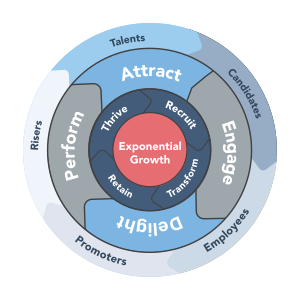
DELIGHT
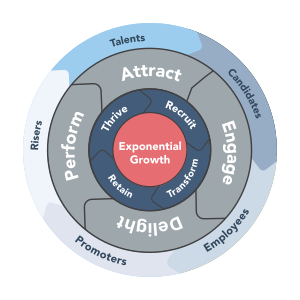
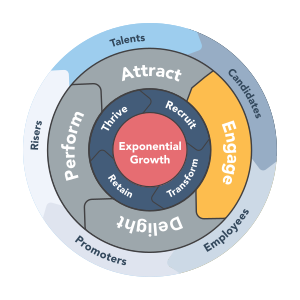
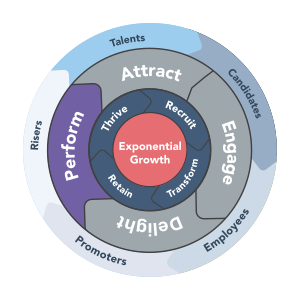
Flywheel
Managers, team leaders, and people managing teams
Target Audience
Min 8 — Max 16
Number of Participants
1 day
Duration
In-person — Live online
Delivery Method
TR / EN
Language Option
Pre-Assessment
None
Customization
None
Behavioral EQ® Multi-Rater Değerlendirmesi
Assessment
Pre-Work
Available
Training Kit
Available
Gamification
Available
Certification
Available
Reward
Available
Additional Resources
Available
Post-Training Reinforcement
Optional
ROI Measurement
Optional
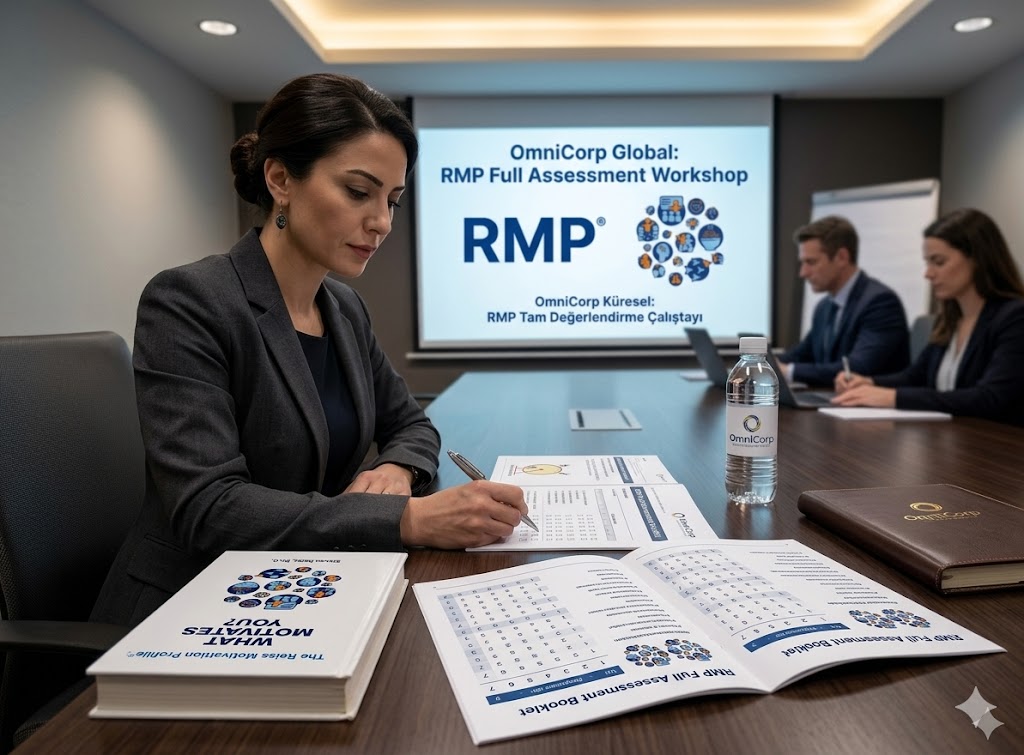
RMP Team Motivation Training — Social Style Training
Next Available Trainings