Self-Directed Learning

You've invested in learning platforms, content, training, and AI tools. But are your employees taking ownership of their own development—or does that responsibility still rest with your organization?

flash-yellow
flash-yellow

DID YOU
KNOW?

training-data-vector

49%

 Even when learning is required for their role, only 49% of employees choose to engage in learning.  

The problem isn’t access. Employees have unlimited access to content, training, and AI tools; however, they aren’t taking ownership of their learning. Learning is perceived not as a skill the employee must develop on their own, but as “a task assigned by the company.”

Trending Down LinkedIn Learning, 2021

Common Problems We See in Many Organizations

non-systematic work management no-systematic-work-management-hover
Learning is viewed not as a means of developing competence, but as a tool for career advancement.
Decisions Made at the Meeting decisions-in-meeting-hover
Developing skills is not seen as part of the job, but rather as time taken away from work.
organization-2
busy people busy-people-hover
While the digital world makes learning easier, a lack of focus, deep thinking, and the tendency to rely on artificial intelligence make it harder to develop skills.
peoples-head people's heads hover
Employees are constantly expected to acquire new skills, but they are never taught how to develop them.
non-systematic work management no-systematic-work-management-hover
Learning is viewed not as a means of developing competence, but as a tool for career advancement.
Decisions Made at the Meeting decisions-in-meeting-hover
Developing skills is not seen as part of the job, but rather as time taken away from work.
busy people busy-people-hover
While the digital world makes learning easier, a lack of focus, deep thinking, and the tendency to rely on artificial intelligence make it harder to develop skills.
peoples-head people's heads hover
Employees are constantly expected to acquire new skills, but they are never taught how to develop them.

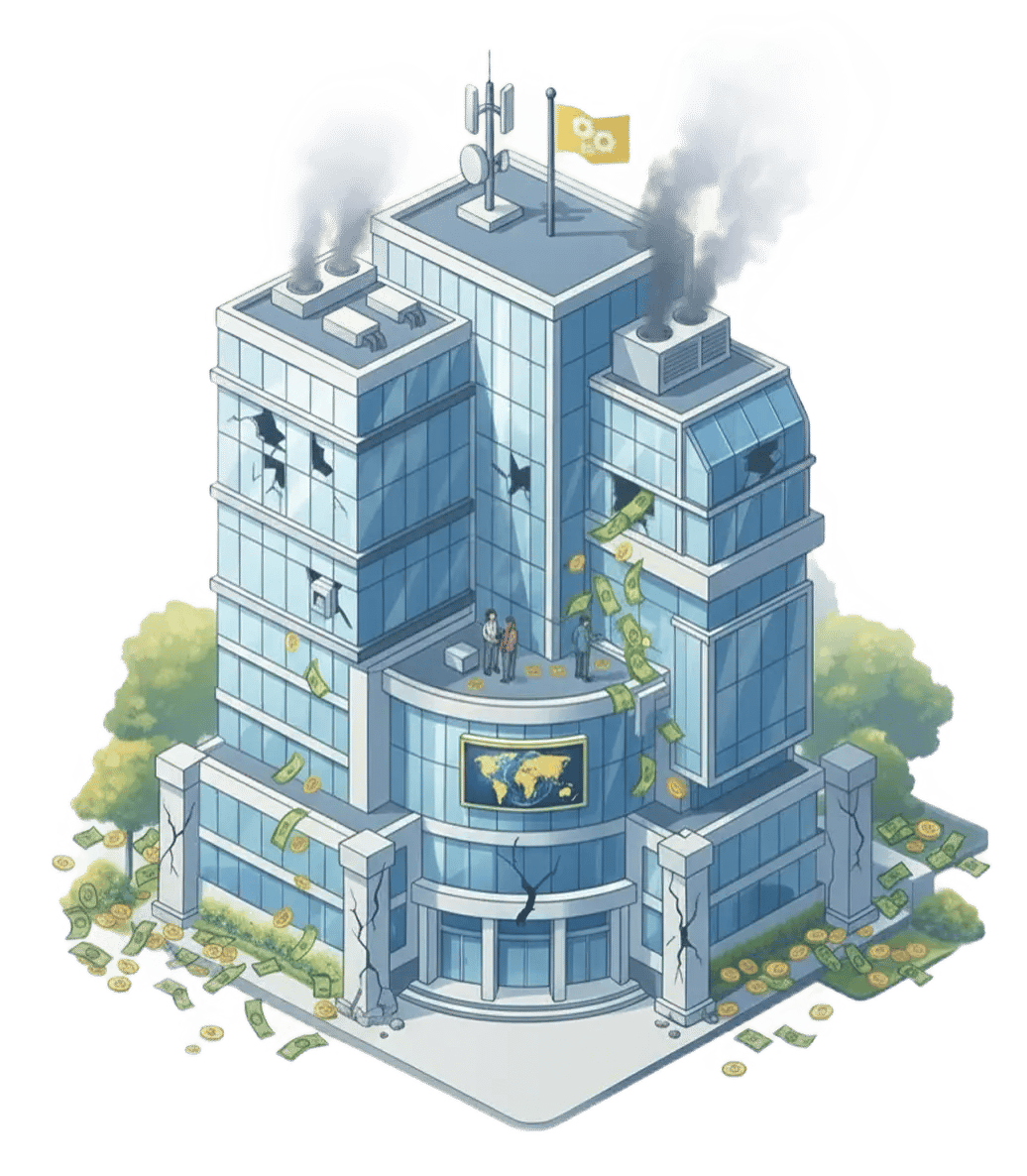
The Hidden Costs of Problems

trend-down-1

Operating Costs

The skills gap costs an average of $1.3 million per company per year—including a drop in productivity of up to 20 percent. While employees can devote only 1 percent of their workweek to professional development, employees continue performing their work using outdated skills; when skills plateau, performance also reaches its ceiling. — Source: INOP, 2026 | Deloitte

profile-2user-white

Cultural Cost

Companies worldwide spend more than $350 billion on training each year; yet only 12% of employees apply what they’ve learned to their jobs. This is why the perception that “training doesn’t change anything” has taken root in organizations and among managers—and it’s largely justified. Yet companies continue to pay for these ineffective training programs because they are designed not to develop competencies, but simply to be “checked off the list.”— Source: Harvard Business Review

strategic-outcome

Strategic Cost

An organization’s primary strategic risk is its inability to adapt to change when its employees cannot develop their skills. This difference is clearly evident in the AI transformation: When Salesforce had AI handle approximately half of its customer interactions, it reduced its support team from 9,000 to 5,000. IKEA, on the other hand, retrained the 8,500 employees affected when its chatbot took over 47% of calls, transforming them into interior design consultants—this channel generated 1.3 billion euros in revenue in its first full year. The difference lies in employees’ ability to adapt to new roles; a workforce unable to develop itself makes the company’s transformation impossible.— Source: CNBC, 2025 | Ingka Group / Reuters, 2023

If the Erosion of Trust Continues

early-signals
10 DAYS

Every change brings with it new expectations for training. Organizations expect employees to learn and acquire new skills; however, employees do not take the initiative to start learning on their own. The cost of this, however, goes unnoticed at first.

cultural shift
10 MONTHS

The company is trying to transform, and people are trying to adapt. However, because the pace of change has outpaced the pace of learning, every transformation takes longer than planned, and every new competency is acquired later than expected. When the organization cannot develop capacity at the expected pace, it turns to short-term solutions; some decisions are made hastily, while others are constantly postponed.

structural damage
10 YEARS

The organization can no longer grow with its own people. This is because there aren’t enough employees who take ownership of their learning or serve as role models for development. Every new competency is acquired from outside, and every major transformation is attempted to be addressed through new hires. The company is transforming into an organization that constantly buys in new competencies from outside rather than developing them internally.

What Skills Are Needed to Solve This?

The most important common trait of organizations that can keep pace with the speed of change is their employees’ ability to manage their own development.  Self-Directed Learning is the capability that enables an individual to recognize their development needs, plan their learning process, access the right resources, apply what they have learned, and turn this into a sustainable habit.

HelpCircle

Notice → Plan → Learn → Apply

The key to rapidly developing new skills isn’t what you teach people; it’s teaching them how to manage their own learning.

testimonial-quote-icon

“The most valuable skill of the future is the ability to develop new skills on your own.”

What Is This Program?

Self-Directed Learning is a program designed to strengthen organizations’ capacity to build competencies. It teaches employees not what to learn, but how to manage their own development in the face of change.

The program is based on the Learn • Unlearn • Relearn methodology. By transforming their current learning habits, participants gain a sustainable learning discipline that enables them to independently develop new competencies throughout their careers.

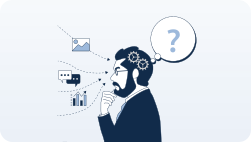
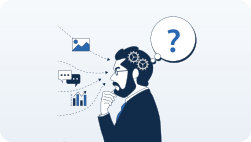
depositphotos_619482778-stock-photo-side-view-thinking-businessman-crypto

What Will You Learn?

Participants learn and apply what they’ve learned in real-world business scenarios.

Module 1 — Learn: Learn to Manage Your Own Learning

Everyone learns differently. The program first helps you discover your own learning tendencies and development habits. You will then learn to accurately analyze your development needs, plan your learning process, select the right resources, and systematically apply what you’ve learned. In this way, learning ceases to be a one-time activity and becomes a natural part of your daily work routine.

Module 2 — Unlearn: Leave Old Habits Behind

One of the biggest obstacles to change is not a lack of knowledge, but old ways of thinking and working. In this module, you’ll learn to recognize the patterns that are slowing down your growth, consciously let go of habits that no longer add value, and develop new behaviors that will help you adapt to change more quickly.

Module 3 — Become a Professional Who Continually Evolves in the Age of AI
In the age of artificial intelligence, learning isn’t about consuming more information; it’s about asking the right questions, thinking alongside AI, and rapidly developing new skills. In this module, you’ll learn to use artificial intelligence not as a substitute for thinking, but as a development partner that accelerates learning.

Achievements

training-learning-vector
checkmark_icon
Employee
They recognize their own need for growth; they manage their own development process without waiting for someone else to get them started.
checkmark_icon
Employee
Instead of waiting to ask, “When will there be training for this?” when faced with a new tool, system, or role, they create their own learning path.
checkmark_icon
Employee
It uses artificial intelligence not as a substitute for human thought, but as a work partner that accelerates its learning and development.
checkmark_icon
Team / Manager
It builds teams from the burden of having to guide your team one by one through each new skill; it delegates the responsibility for learning to the team.
checkmark_icon
Team / Manager
It builds teams that can adapt on their own during times of change, rather than waiting for direction from outside.
checkmark_icon
Team / Manager
It fosters a leadership approach that encourages learning rather than controlling the learning culture.
checkmark_icon
Organization
It transforms into an organization that can develop new competencies internally rather than purchasing them from outside sources.
checkmark_icon
Organization
It fosters a strong capacity for adaptation, enabling the organization to adopt new technologies, processes, and ways of working more quickly.
checkmark_icon
Organization
It transforms into an organization that can continuously develop new capabilities from within and lead change through its own people.

Who Is It For?

tick-circle-green Who Is It For?
Organizations that want their employees to take ownership of their own development
Organizations that want to turn learning into a continuous habit rather than a one-time training session
Organizations seeking to build new competencies in line with their business strategy
Organizations seeking to accelerate the pace of learning in the age of artificial intelligence and digital transformation
Organizations that want to create a learning organization culture that builds its own capabilities
close-circle-yellow Who Might It Not Be Suitable For?
Organizations that want to delegate responsibility for development to employees rather than foster a culture of learning
Organizations that view training as an activity and learning as a task to be completed
Organizations that are unable to translate new business needs into new learning needs
Organizations that invest in new technologies but fail to invest in people’s ability to learn
Organizations that do not believe that continuous learning is the foundation of building new competencies
danger Urgent

Why Now?

info-icon

AI has permanently changed the equation of learning.

Artificial intelligence is transforming every business function. However, the biggest challenge organizations face is not access to information; it is how quickly employees can apply new skills to their work. General and one-time training sessions are no longer sufficient; new skills must be developed on the job, on a role-by-role basis, and continuously.

It is no longer possible for companies to develop every employee individually.

As business needs change, new learning needs arise. However, given this pace of change, it is not sustainable for HR and L&D teams alone to bear the entire burden of learning. The organizations of the future will be those that foster a culture of learning and empower employees to take ownership of their own development.

The most effective learning isn't assigned—it is self-initiated; it is the kind that the employee initiates on their own.

In organizations where employees begin learning on their own initiative, learning ceases to be a requirement and becomes a habit. At Cruise, where learning is left to the employees’ own rhythm, a 97% completion rate was achieved in voluntary programs—even though no one was forced to participate—and managers’ self-confidence increased by 43%.

Competitive advantage is now determined by the speed of learning.

A workforce capable of managing its own development adapts to change much more quickly. At Wolters Kluwer, employees adapted to artificial intelligence in just three weeks, increasing their use of AI tools by 120%. Because what makes the difference now isn’t which organizations provide the most training; it’s which organizations enable their people to develop the fastest.

testimonial-quote-icon

“In the past, competitive advantage was determined by knowledge. Today, it is determined by how quickly you can learn new information and how quickly you can turn it into new competencies.”

HubSpot
State of Service 2024

Related Solutions

Gemini_Generated_Image_dfgvqfdfgvqfdfgv (1) Assessment

Self-Directed Learning Profile

Prior to the program, it assesses employees’ tendency to take charge of their own learning and their development habits. (The natural starting point for the program.)

power-of-habit Assessment

RMP for Learning Culture Analysis

It analyzes learning motivation and the organizational learning culture at the root level of motivation using the Reiss Motivation Profile.

unnamed (19) Assessment

Learning Culture Index

It measures the organization’s learning culture maturity at the organizational level; it tracks the program’s impact across the entire organization.

power-of-habit Speech

Learning to Learn: The Only Skill That Never Expires

An opening speech explaining why learning is the most critical and timeless skill.

power-of-habit Speech

Self-Learning in the Age of AI

A talk exploring how self-learning translates into a competitive advantage in the age of AI.

Overview

tag-2

Self-Directed Learning

Product Name
tag-2

SP1 Success Program (In-House Original)

Partner
tag-2

LERG (Learning Gaps)

Challenge
tag-2

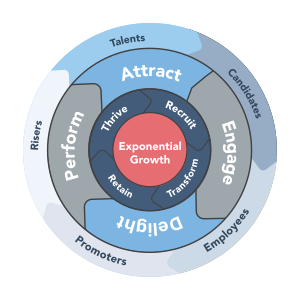
DELIGHT

Flywheel
tag-2

All Employees, Teams, Leaders, and L&D Professionals

Who Should Attend
tag-2

Min 8 - Max 16

Number of Participants
tag-2

1 Day (3 Modules)

Duration
tag-2

In-Person - Live Online - E-Learning

Delivery Format
tag-2

TR / EN

Language Option
tag-2

Available — RMP

Preliminary Assessment
tag-2

Not Available

Customization
tag-2

Self-Directed Learning Profile

Inventory
tag-2

Optional (Reading + Video)

Preliminary Preparation
tag-2

Workbook, User Guide, Cards

Educational Kit
tag-2

Exists

Gamification
tag-2

Yes — Certificate of Participation

Certificate
tag-2

Optional

Award
tag-2

Books, Video Library, Articles

Additional Resources
tag-2

Optional

Post-Training Retention
tag-2

Optional

ROI Measurement
tag-2

RMP: Who Am I?

Next Training
profile-2user

LERG-PTP-SDL-SP-URS-LND-DEV-DEL-104

SKU