Lead Young Talent

What if the problem isn't young talent? What if we’re misinterpreting their behavior?

flash-yellow
flash-yellow

DO YOU KNOW
?

training-data-vector

54%

54% of young employees say the feedback they receive from their manager doesn't reflect how they see themselves. 

The same behavior can be interpreted in different ways. While one side may perceive a performance issue, the other feels misunderstood.  This is where the leadership gap behind the generation gap begins. 

Trending Down LinkedIn Learning, 2021

Common Challenges We See in Many Organizations

In many organizations, leaders encounter a similar situation when working with young talent:

non-systematic work management no-systematic-work-management-hover
The same leadership approach is applied to young talent, but it doesn’t have the same effect—the approach applied to everyone doesn’t produce the same result for everyone.
Decisions Made at the Meeting decisions-in-meeting-hover
Leaders provide feedback, but the same conversation produces two very different outcomes.—while the leader believes they are offering a development opportunity, the young talent feels they are being criticized.
organization-2
busy people busy-people-hover
Leaders try to understand what motivates people, but often rely on assumptions. What motivates one person may discourage another.
peoples-head people's heads hover
Leaders maintain an open-door policy, yet the real issues often remain unspoken. By the time problems surface, it's usually too late.
non-systematic work management no-systematic-work-management-hover
The same leadership approach is applied to young talent, but it doesn’t have the same effect—the approach applied to everyone doesn’t produce the same result for everyone.
Decisions Made at the Meeting decisions-in-meeting-hover
Leaders provide feedback, but the same conversation produces two very different outcomes.—while the leader believes they are offering a development opportunity, the young talent feels they are being criticized.
busy people busy-people-hover
Leaders try to understand what motivates people, but often rely on assumptions. What motivates one person may discourage another.
peoples-head people's heads hover
Leaders maintain an open-door policy, yet the real issues often remain unspoken. By the time problems surface, it's usually too late.

The Hidden Costs of Problems

trend-down-1

Performance Cost

The highest potential may never be realized. The value of young talent cannot be measured solely by their current performance; their rate of learning, curiosity, and initiative are the strongest indicators of the impact they will have in the future. When mismanaged, these qualities fade—and the real loss isn't today's performance—it's tomorrow's potential. Deloitte, 2025: Development and learning opportunities are among the top three reasons young employees choose an employer.

profile-2user-white

Cultural Cost

Young employees stop learning from their leaders. For an employee in the early years of their career, a leader is not just a manager—they are their first role model. When trust isn’t established, young talent eventually learns not to ask questions, not to take risks, and to stay out of the spotlight. SP1 field observation

strategic-outcome

Strategic Cost

A company begins losing its future leaders today. Every young talent lost today is also the loss of a potential leader who could have been developed from within. Randstad, 2025: The average tenure of young employees is 1.1 years—the shortest of any generation.

If the Erosion of Trust Continues

A misinterpreted behavior is a one-time misunderstanding; when it continues to be misinterpreted, it becomes an organizational habit.

early-signals
10 Days
Trust is shaken. The young talent begins to feel that his or her behavior and intentions are being misunderstood. There is no visible problem yet; however, the bond of trust begins to crack for the first time.
cultural shift
10 MONTHS

Behavior changes. Young employees now ask fewer questions, make fewer suggestions, and take fewer risks. Instead of demonstrating their potential, they prefer to avoid making mistakes. The problem doesn’t go away; it simply becomes invisible.

structural damage
10 YEARS

The culture changes. Over time, an organization can only retain people who conform to the prevailing leadership philosophy. Those who think differently leave, and those who remain become more alike. As a result, a leadership approach that fails to understand young talent becomes ingrained in the company’s culture and is passed on to future generations of leaders.

testimonial-quote-icon

Young talent is not lost because it has lost its potential; it is lost because it has not found the leadership to bring that potential to the surface.

What Competency Is Needed to Solve This Problem?

 The capability required  to solve this problem is the ability to lead effectively, tailored to the individual.

Even among young employees within the same generation, people are motivated by different reasons, have different expectations, and respond differently to the same feedback. Therefore, effective leadership is not about applying the same approach to everyone; it is about accurately reading the person in front of you and adapting your leadership approach accordingly.

HelpCircle

Effective Leadership for Individuals

Ability

This ability does not develop intuitively. This is because people often interpret others based on their own motivations, experiences, and understanding of leadership. To build a sustainable connection with young talent, there is a need for a common language and a reliable method that will enable leaders to move beyond these assumptions.

What Is This Program?

The Lead Young Talent Training is a Leadership OS™ program that enables leaders to adapt their leadership approach to each individual by understanding young talents based on their personal motivations rather than generational stereotypes.

At the heart of the program is the Reiss Motivation Profile® (RMP), which reveals the motivations behind individuals’ behaviors. The RMP provides a common language that enables leaders to understand young talent  rather than assumptions, but through scientific motivation data.

This approach is supported by a 360° Leadership Assessment. Leaders gain insight not only into how they manage young talent but also into how they are perceived by them.

As a result, Lead Young Talent does not simply teach leaders to provide more leadership to young talent; rather, it equips them with the ability to lead effectively based on each individual’s motivations and expectations.

depositphotos_619482778-stock-photo-side-view-thinking-businessman-crypto

What Will You Learn?

Participants will develop behaviors focused not on managing young talent, but on providing leadership tailored to each individual by accurately understanding them. By the end of the program, they will be able to apply the following in a real-world work environment:

Reading behavior — Assessing the individual motivations behind young employees’ behavior based on objective data, not assumptions.

Adapting the leadership approach — Developing an approach to feedback, recognition, and development that aligns with each individual’s motivation, expectations, and work style as they work toward the same goal.

Understanding your leadership impact —to recognize how your leadership style is perceived by young talent and to work on your blind spots.

Building psychological safety—establishing a work environment where young employees feel comfortable expressing their ideas and are not hesitant to ask questions or take on responsibilities.

Turning potential into performance — Ensuring that high-potential young employees make long-term contributions by supporting their learning pace, engagement, and development.

Achievements

training-learning-vector
checkmark_icon
Moves from assumption-based leadership to evidence-based leadership.
checkmark_icon
It shifts from the ease of applying the same approach to everyone to the flexibility of leadership tailored to the individual.
checkmark_icon
Leaders become aware of their blind spots and consciously manage their impact on others.
checkmark_icon
Young employees share their ideas more freely, take more initiative, and actively pursue opportunities for growth.
checkmark_icon
As psychological trust grows, intergenerational communication and cooperation improve.
checkmark_icon
The contributions of high-potential employees become apparent.
checkmark_icon
By identifying the potential of young talent early on, it strengthens the pool of future leaders.
checkmark_icon
It transforms leadership quality into a key factor in engagement and retention for young talent.
checkmark_icon
It supports the sustainable transfer of knowledge, experience, and a culture of leadership across generations.
Young talents are not the future of a company. Leaders who can bring out their potential are the future of the company.

Who Is It For?

tick-circle-green This program is for the following leaders
Leaders who recognize that it is their responsibility to understand young talent.
Leaders who understand that the same leadership approach will not produce the same result for everyone.
Leaders who strive to understand the motivation behind behavior.
Leaders who are curious about the impact of their leadership style on young employees.
Leaders who see young talent not as today’s employees, but as tomorrow’s leaders.
close-circle-yellow This program is not intended for these leaders
Leaders who see the problem solely in the attitudes of the "new generation."
Leaders who say, "I lead others the same way I was led."
Leaders who are quick to label behavior but do not question intent.
Leaders who expect young employees to change without questioning their own leadership style.
Leaders who view young employees merely as a resource to handle today’s workload.
danger Urgent

Why Now?

info-icon

Young talent is no longer the future of the workforce—it’s the present.

Gen Z is set to become one of the largest groups in the workforce in the coming years. Understanding young talent is no longer just a matter for specific teams; it has become a leadership issue for the entire organization. (McKinsey / BLS)

The balance of power has shifted.

It’s no longer just companies that select their employees; employees also select their leaders. For young talent, leadership quality is becoming just as important a selection criterion as salary and benefits. As a result, leadership is becoming a strategic factor that determines not only performance but also talent retention. (Randstad Workmonitor, 2025)

Artificial intelligence is highlighting the importance of nurturing young talent.

As artificial intelligence takes over repetitive tasks, many organizations are cutting back on entry-level roles. However, these roles don’t just generate work; they also nurture the leaders of the future. Companies that fail to invest in the development of young talent may save costs in the short term but risk losing their pool of home-grown leaders in the long run. Because while artificial intelligence can transform jobs, only leaders can develop the leaders of the future.

Related Solutions

Gemini_Generated_Image_dfgvqfdfgvqfdfgv (1) Assessment

RMP for Managing Gen Z

It reveals the young talent’s motivation profile at the individual level; it provides data to support the leader’s ability to “lead based on the individual.”

power-of-habit Assessment

360° Leadership Assessment

It measures how young employees perceive their leader; it brings blind spots to light.

unnamed (19) Program

Next-Generation Leadership

It focuses not only on managing young talent but also on preparing them to become future leaders; it is the natural continuation of Lead Young Talent.

power-of-habit Program

HiPo (High Potential) Talent Management

It focuses on the early identification and development of high-potential employees; it integrates the potential identified by Lead Young Talent into a systematic process.

power-of-habit Program

Leading the Younger Generations

It helps young talent deepen their leadership skills through individual coaching; it reinforces what is learned in the classroom with one-on-one development.

power-of-habit Consulting

Aligning Talent Management with Learning Initiatives

It links the development of young talent to the organization’s talent and learning strategy; it translates individual growth into the organizational system.

Overview

tag-2

GEND-PTP-LYT-SP-LDE-LEA-LEAD-ENG-XXX (SEQ deferred)

SKU
tag-2

SuccessProgramme

Partner
tag-2

GEND — Generation Gap (🔥 Critical) · CH2: LEC

Challenge
tag-2

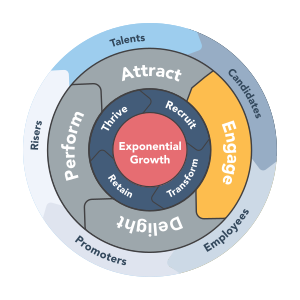
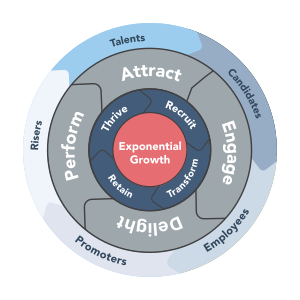
ENGAGE

Flywheel
tag-2

Leaders of Young Talent

Who Should Attend
tag-2

12–16 people

Number of Participants
tag-2

3 Days

Duration
tag-2

In-person / virtual class · workshop format

Delivery Method
tag-2

Turkish / English

Language Option
tag-2

Reiss Motivation Profile® + 360° Leadership Assessment

Preliminary Assessment
tag-2

Included

Customization
tag-2

Reiss Motivation Profile®

Assessment Tools
tag-2

360° Leadership Assessment

Pre-Program Preparation
tag-2

Lead Young Talent™ Participant Handbook + Implementation Guide

Training Kit
tag-2

Included

Gamification
tag-2

SuccessProgramme Leadership OS™ Certificate of Participation

Certificate
tag-2

Included

Award
tag-2

Included

Additional Resources
tag-2

Included

Post-Training Retention
tag-2

Optional

ROI Measurement
tag-2

Next-Generation Leadership · High-Potential Talent Management · Leading Younger Generations

Next Training Sessions